
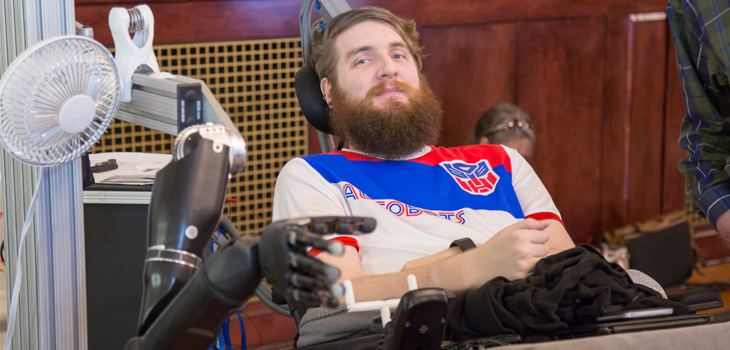
Ten years ago Nathan Copeland was robbed of his ability to feel sensation in his arms and fingers when he was involved in a car accident. Copeland, a 30-year-old paralyzed man, has regained the sensation of touch. Thanks to technology developed by researchers at the University of Pittsburgh and the University of Pittsburgh Medical Center (UPMC), Copeland can now experience touch via a robotic arm that he controls with his brain. This project, a first-in-human milestone, was led by Robert Gaunt, Ph.D., assistant professor of physical medicine and rehabilitation at “Pitt.”
Brain-Computer Interface Helps Paralyzed Man Feel
2 min read Premium comments
Secondary
“The most important result in this study is that microstimulation of sensory cortex can elicit natural sensation instead of tingling, ” said study co-author Andrew B. Schwartz, Ph.D., distinguished professor of neurobiology and chair in systems neuroscience, Pitt School of Medicine, and a member of the University of Pittsburgh Brain Institute, in the October 13, 2016 news release. “This stimulation is safe, and the evoked sensations are stable over months. There is still a lot of research that needs to be carried out to better understand the stimulation patterns needed to help patients make better movements.”
Michael Boninger, M.D., professor of physical medicine and rehabilitation at Pitt, and senior medical director of post-acute care for the Health Services Division of UPMC, told OTW, “I saw during medical school how much technology could help people, and truly help them get better—be more independent. It worked well with my engineering degree and I found it rewarding. The move to brain computer interface (BCI) work was based on having great collaborators needed to build a team. Early on this was specifically Andy Schwartz and Doug Webber. Working in the BCI area offers a chance to transform a field.”
“Many orthopedic surgeons treat the spine or limb trauma that results in amputation and spinal paralysis. I think they can point to this work as something their patients can look towards as providing better function in the future. It might be a good way to introduce rehabilitation and the rehabilitation team that care for patients with amputation and spinal cord injury long term.”
“I have seen patients who see this ground breaking work and decide that they don’t need to do the hard work of rehabilitation. They believe a cure is around the corner, so why learn to use a wheelchair or prosthetic. But, this technology is still experimental and has some distance to go before orthopedic surgeons will be part of the clinical team that makes them a reality. In the meantime, the entire team has to let people know that the hard work of rehabilitation is essential and will actually make them better suited for brain computer interfaces when they become a clinical reality.”
Author
React:
Discussion
This is a fascinating development. In my practice we've seen similar outcomes with the revised protocol. The key differentiator seems to be patient selection criteria. Has anyone else noticed the correlation with BMI thresholds?
Great point. I'd push back slightly on the conclusion, the sample size in the cited study is too small to draw population-level inferences. That said, the directional signal is compelling and worth a larger RCT.
We implemented a similar approach last year. Early results are promising but we're still gathering 12-month follow-up data. Happy to share our protocol if anyone is interested.
Join the conversation
Orthopedic professionals are discussing this. Sign in and upgrade to read every comment and add your voice.