
Spines in space…what happens to them? New work funded by NASA attempted to delve into what affects lumbar spine strength and low back pain during long-duration spaceflights.
Astronauts’ Spine Atrophy: Clues for the Rest of Us
2 min read Premium comments
Secondary
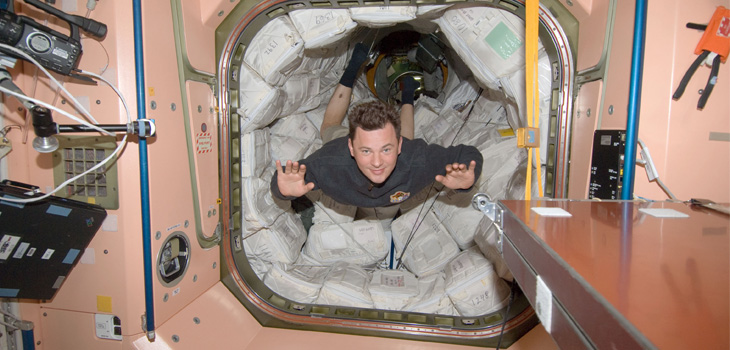
As stated in the October 24, 2016 news release, “Six NASA crewmembers were studied before and after spending four to seven months in ‘microgravity’ conditions on the International Space Station [ISS]. Each astronaut underwent magnetic resonance imaging (MRI) scans of the spine before their mission, immediately after their return to Earth, and again one to two months later.”
Douglas G. Chang, M.D., Ph.D. of the University of California, San Diego (UCSD), and colleagues found that “astronauts on long missions in space have atrophy of the muscles supporting the spine—which don’t return to normal even several weeks after their return to Earth…These changes are accompanied by an increase in body height (about two inches), thought to result from spinal ‘unloading’ and other changes related to the lack of gravity. The researchers used an image ‘thresh-holding’ technique to estimate lean muscle separated from non-lean muscle components.”
“In contrast, there was no consistent change in the height of the spinal intervertebral discs. Dr. Chang and co-authors write, “These measurements run counter to previous hypotheses about the effects of microgravity on disc swelling.”
Dr. Chang, chief of physical medicine and rehabilitation service at UCSD, told OTW, “As an athlete and engineering student, I’ve always been interested in movement and performance. In college I had the good fortune of studying with Dr. Manohar Panjabi at Yale and Dr. Jiri Dvorak (Schulthess Klinik), who introduced me several decades ago to the spine as a topic. With a good appetite for science fiction growing up, this study of the spine in space was a natural fit for me. I was very excited to apply this background to address some of the big concerns on NASA Human Research Program roadmap (https://www.nasa.gov/hrp). Alan Hargens, Ph.D., myself and the rest of the team were even happier when NASA saw fit to fund our research proposal.”
“What I found most medically interesting was the significant degree of muscle atrophy compared to the disc, and also how much more dramatic the changes are in the cervical spine (research is forthcoming in that area). I would like orthopedic surgeons to appreciate not only the surgical implications of muscle sparing (which they already have some recognition) but also hope this is a reminder about the rehabilitation process. This means exercise countermeasures before/during/after a mission on the ISS or a medical procedure on Earth. And this means that there is more to back pain than just exercise. And exercise is more than just strengthening, but involves retraining of neuromuscular coordination and other factors. Above all, back pain is a condition with many facets, involving factors such as psychological attitudes all the way down to molecular changes in the muscle cells themselves.”
Author
React:
Discussion
This is a fascinating development. In my practice we've seen similar outcomes with the revised protocol. The key differentiator seems to be patient selection criteria. Has anyone else noticed the correlation with BMI thresholds?
Great point. I'd push back slightly on the conclusion, the sample size in the cited study is too small to draw population-level inferences. That said, the directional signal is compelling and worth a larger RCT.
We implemented a similar approach last year. Early results are promising but we're still gathering 12-month follow-up data. Happy to share our protocol if anyone is interested.
Join the conversation
Orthopedic professionals are discussing this. Sign in and upgrade to read every comment and add your voice.