
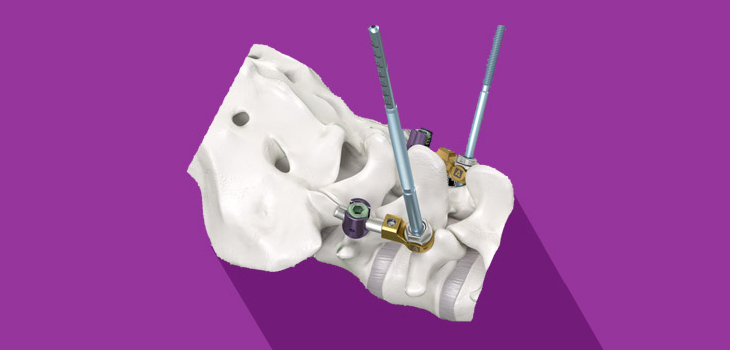
Amendia, Inc., a manufacturer of medical devices used in spinal surgical procedures, announces the commercial launch of its spondylolisthesis reduction system called the Syzygy Stabilization System. The system is configured to provide immobilization and stabilization of spinal segments as an adjunct to fusion. Physicians also use Syzygy in the treatment of instabilities or deformities of the thoracic, lumbar, or sacral spine; and conditions such as fracture, dislocation, scoliosis, kyphosis, spinal tumor, or failed previous fusion.
Amendia Launches Syzygy Spinal Stabilization System
1 min read Premium comments
Secondary
The Syzygy System is made of implant-grade titanium alloy. It features cannulated and non-cannulated screws, with self-tapping “grip quick” threads for maximum cortical bone purchase. Extended threads allow increased adjustability and control in 5mm increments for accurate reduction of spondylolisthesis. With available medial and cranial couplers, Syzygy facilitates up to 35mm of reduction with ±10° of cranial-caudal adjustment.
Hewatt M. Sims, M.D., a fellowship-trained orthopedic spine surgeon at Orthopedic Spine Center and Tift Regional Medical Center in Tifton, Georgia, performed spine surgeries with Syzygy. He reports that “Syzygy is a unique spinal system, providing quick, precise, and consistent reduction of the spondylolisthesis deformity.”
Lawrence Boyd, Amendia’s executive vice president of Research & Development, said, “In working hand in hand with the medical community and spinal device marketplace, we know how important it is to provide patients and surgeons with a pedicle screw-based solution that consistently and accurately realigns the spine. With surgeons providing care for a large number of patients who engage in athletics and rigorous physical activity, combined with a growing aging population, this critical addition to our line of lumbar fixation products will provide another way for surgeons to evolve their care.”
in Marietta, Georgia based Amendia is a designer, developer, manufacturer and marketer of medical devices used in spinal surgical procedures. Company officials say that the company works to create balanced solutions with disruptive technologies for medical devices paired with biologics and instrumentation. They say that Amendia’s vertically-integrated strategy focuses on improving surgical outcomes and the lives of patients with spinal disorders.
Author
React:
Discussion
This is a fascinating development. In my practice we've seen similar outcomes with the revised protocol. The key differentiator seems to be patient selection criteria. Has anyone else noticed the correlation with BMI thresholds?
Great point. I'd push back slightly on the conclusion, the sample size in the cited study is too small to draw population-level inferences. That said, the directional signal is compelling and worth a larger RCT.
We implemented a similar approach last year. Early results are promising but we're still gathering 12-month follow-up data. Happy to share our protocol if anyone is interested.
Join the conversation
Orthopedic professionals are discussing this. Sign in and upgrade to read every comment and add your voice.