
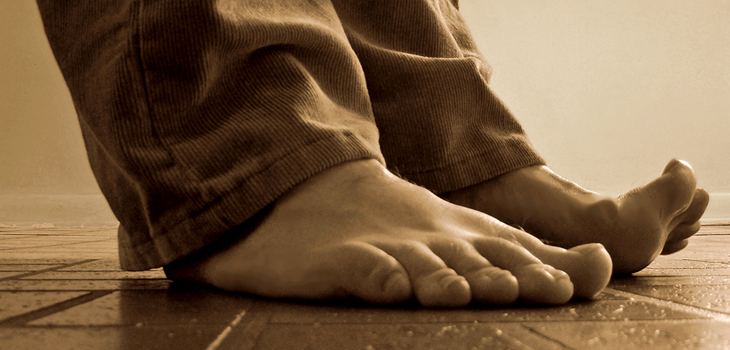
Toe stretching exercises, in which the toes are stretched sidewise, have gained some currency as a treatment for foot pain. Evidence for its usefulness is slight but one study, reported by Laura Johannes for the Wall Street Journal, found that foot stretching when it was done with Yoga Toes, a device from Fen F LLC, of Dexter, Michigan, eased muscle contractions in the feet of patients with Parkinson’s disease.
Toe Stretching Urged For Foot Pain
1 min read Premium comments
Secondary
Yoga Toes is a ladder-shaped plastic gel instrument that a patient places on his feet between each of his toes, moistening it first so it slides on easily. The device forces the toes apart and, according to its proponents, helps with a wide variety of foot pain. The device sells for $39.95 and comes in three sizes.
Grace Torres-Hodges, M.D., a podiatric surgeon in Pensacola, Florida, and a spokeswoman for the American Podiatric Medical Association, says that stretching your toes laterally elongates the muscles and keeps them relaxed. Stretching is not a cure for conditions such as hammertoes or bunions, she says, but in some patients may ease pain.
For toe-stretching to be most effective for treating foot pain one should combine it with strengthening exercises, such as picking up marbles from the floor with ones toes, says Jordan D. Metzl, M.D., a sports medicine physician at the Hospital for Special Surgery, in New York City.
Iyengar yoga teacher Roger Cole, in Del Mar, California, says that when most students come to yoga class, they are not able to separate all their toes sideways from each other. He advises them, to lean over and manually separate their toes. Over time, he says, they can learn to keep their toes separated in all standing poses.
Author
React:
Discussion
This is a fascinating development. In my practice we've seen similar outcomes with the revised protocol. The key differentiator seems to be patient selection criteria. Has anyone else noticed the correlation with BMI thresholds?
Great point. I'd push back slightly on the conclusion, the sample size in the cited study is too small to draw population-level inferences. That said, the directional signal is compelling and worth a larger RCT.
We implemented a similar approach last year. Early results are promising but we're still gathering 12-month follow-up data. Happy to share our protocol if anyone is interested.
Join the conversation
Orthopedic professionals are discussing this. Sign in and upgrade to read every comment and add your voice.