
Stryker Corporation is expanding the company’s extremities offerings by buying all the assets of Restore Surgical LLC. Restore Surgical does business as Instratek.
Stryker Acquires Instratek Extremity Products
1 min read Premium comments
Secondary
Terms of the acquisition were not included in a Stryker announcement on September 14, 2016.
Instratek was founded in 1991, is privately held and headquartered in Houston, Texas. The company makes staple and hammertoe implants and minimally invasive soft tissue recession instrumentation for foot, ankle and upper extremity procedures.
Instratek’s website says the company has been focused on “the development, manufacturing, and marketing of leading-edge orthopedic implants and endoscopic instrumentation for the field of extremity surgery.” The company said its products offer “cost effective solutions for the extremity surgeon and healthcare facilities.”
Last December, Instratek announced, “record revenue growth for the 10th straight year.” The company said it recorded, “solid year over year revenue growth.”
In June 2014, the Instratek announced that Jeff Seavey, its former president, had taken ownership of the company and would serve as president and CEO.
Here is what Stryker is buying:
Hand Instrumentation
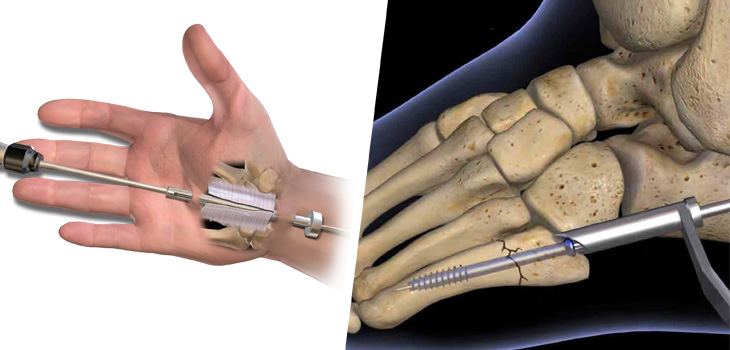
- Endoscopic Carpal Tunnel Release (ECTR) System
- Endoscopic Trigger Finger Release (ETFR) System
- Carpometacarpal Joint Fixation System
- MiNi Cannulated Screw System
Foot and Ankle Instrumentation
- Jones-FX Titanium Screw System
- Endoscopic Plantar Fasciotomy System
- Endoscopic Gastrocnemius Recession (EGR or gastroc recession) System
- Edintrak II Endoscopic Decompression of Intermetatarsal Nerve System
- MiNi Cannulated Screw System
- Sub-Talar Lok Arthroereisis Subtalar Implant System
- STAPiX Superelastic Nitinol Staple Fixation System
- ToeTac Hammertoe Fixation System
David Floyd, Stryker’s orthopedic group president, said the acquisition supports the company’s commitment to growth in extremities, “with products that complement our existing portfolio, strengthen our leadership in the forefoot segment and provide immediate access into minimally invasive soft tissue recession procedures.”
Author
React:
Discussion
This is a fascinating development. In my practice we've seen similar outcomes with the revised protocol. The key differentiator seems to be patient selection criteria. Has anyone else noticed the correlation with BMI thresholds?
Great point. I'd push back slightly on the conclusion, the sample size in the cited study is too small to draw population-level inferences. That said, the directional signal is compelling and worth a larger RCT.
We implemented a similar approach last year. Early results are promising but we're still gathering 12-month follow-up data. Happy to share our protocol if anyone is interested.
Join the conversation
Orthopedic professionals are discussing this. Sign in and upgrade to read every comment and add your voice.