
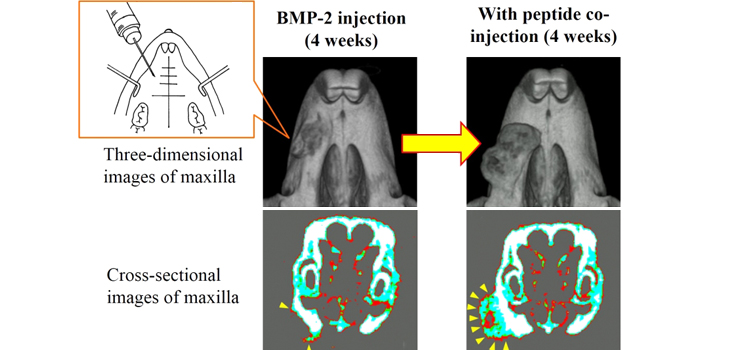
Using a mouse model, Japanese researchers have found out how to deliver a protein/peptide combination using an injectable gel carrier to promote bone formation in jawbones. The scientists, primarily from Tokyo Medical and Dental University (TMDU), have, according to the August 23, 2016 news release, “…injected a gelatin-based gel carrying OP3-4 and BMP -2 [bone morphogenic protein] into mice jawbones to trigger local augmentation of bone around the injection site.”
Protein/Peptide Combo and Gel Promote Bone Formation
2 min read Premium comments
Secondary
“Use of this injectable gelatin-based gel to carry the agents avoids the need for surgical implantation and resulted in no swelling or other such complications in the experimental mice. The researchers observed a region of increased bone mass around the BMP-2 + OP3-4 injection site that was larger than that seen in mice injected with BMP-2 alone, or with other controls. This mass also had a significantly higher bone mineral content and density.”
Corresponding author Kazuhiro Aoki, DDS, Ph.D. told OTW, “Since I am a dentist and always thinking [of] a better way to increase bone mass, I think this convenient and low-invasive method for increasing bone mass could be beneficial for all the dentists. This is the reason why we started this investigation. In the present situations, there is no method to increase bone mass without performing surgical procedures.
“The size of the newly formed bone was not the carrier-size dependent when this new method was applied.” The BMP-2-induced bone will not become bigger than the size of the carrier of BMP-2. Co-injection of our peptide with BMP-2 could accelerate proliferation of the mesenchymal cells which was induced by BMP-2 before starting calcification. This could be the reason why our peptide-co-injection accelerated bone mass than the size of the carrier, which is around 20 micron meter diameter size. One-time-injection could make the vertical bone augmentation! Like bone cement, the orthopedic surgeons would use for the fracture case after approval of this method for clinical applications.
“We could decrease the necessary amount of BMP-2 to increase bone mass. Since BMP-2 has been reported to cause inflammation and increase carcinogenesis in a spinal fusion, the reduced amount of BMP-2 could decrease the frequency of such adverse effects. This method could apply to a fracture case and a spinal fusion, but the appropriate amount of the materials for injections should be examined to prevent over growth of bone.”
Lead author Tomoki Uehara, DDS, told OTW, “For dental treatment, alveolar bone is very important. Alveolar bone loss may lead to tooth loss, and make it difficult to treat by denture and dental implant. In addition, congenital alveolar bone loss requires bone grafting. Therefore, alveolar bone formation is expected to be useful in various dental situations.
“In addition, there have been no known means of stimulating local bone formation without performing surgery so far. In our research, we could induce alveolar bone formation in mice by the low-invasive method of ‘injection.’ Since a single injection is easy and minimally invasive, our bone formation method might be useful for orthopedic surgeons as well as dental treatment.”
React:
Discussion
This is a fascinating development. In my practice we've seen similar outcomes with the revised protocol. The key differentiator seems to be patient selection criteria. Has anyone else noticed the correlation with BMI thresholds?
Great point. I'd push back slightly on the conclusion, the sample size in the cited study is too small to draw population-level inferences. That said, the directional signal is compelling and worth a larger RCT.
We implemented a similar approach last year. Early results are promising but we're still gathering 12-month follow-up data. Happy to share our protocol if anyone is interested.
Join the conversation
Orthopedic professionals are discussing this. Sign in and upgrade to read every comment and add your voice.