
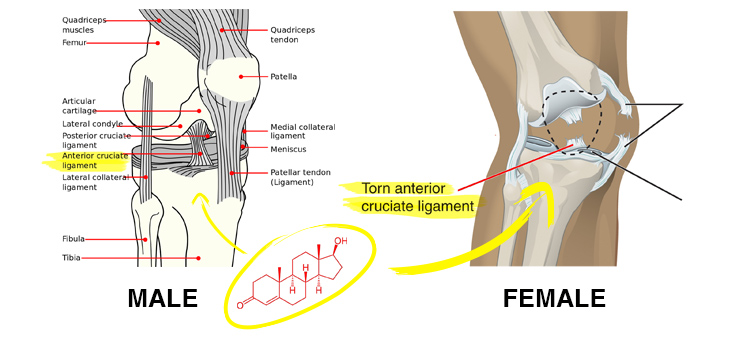
Lab rats at Johns Hopkins are pointing the way toward new information on the sex differences in anterior cruciate ligament (ACL) debate. Scientists have found that testosterone in males may explain why women are up to 10x more likely than men to injure their ACL. Specifically, said the September 20, 2016 news release, “they found that normal male rats with natural supplies of testosterone had stronger ACLs than those that had been castrated and no longer produced the hormone…”
Male Testosterone Responsible for Sex Differences in ACL Injuries?
2 min read Premium comments
Secondary
“The primary implication of the study is that testosterone may contribute to the ACL’s ability to withstand tensile loads and may be one of multiple factors response for the disparate ACL injury rate between men and women, ” says William Romani, Ph.D., M.H.A., a physical therapist and sports medicine researcher who was a visiting faculty member in The Johns Hopkins University’s Department of Biomedical Engineering from 2009 to 2015. Romani now works with the AARP Foundation’s Experience Corps.
As indicated in the news release, senior study author Jennifer Elisseeff, Ph.D., a biomedical engineer at The Johns Hopkins University, says the new finding could eventually lead to techniques that use circulating sex hormone levels to identify athletes at higher risk for ACL injury who may benefit from training strategies to strengthen the ligament.
Dr. Romani told OTW, “In my practice working with college athletes I recognized the disparities in ACL injury rates between male and female athletes. Our early work in young women identified an association between ACL strength and sex hormone levels near ovulation, suggesting that estradiol was related to ligament strength in women. The remodeling and strength of many collagen rich connective tissues is modulated by estrogens and androgens. We identified that the human ACL had the receptors for androgens like testosterone. The thought was that where estrogen may be detrimental to ligament strength in women resulting in more ACL injuries, testosterone may make the ligament stronger and result in fewer injuries in men. The next step was determining if testosterone impacted the ACL so we used our animal model in the current study to determine that higher levels of circulating testosterone in male rats were, in fact, related to stronger ligaments.”
Asked about her initial thoughts on which pathways and molecules testosterone and estrogen act through to influence ligament strength, Dr. Romani told OTW, “In our 2010 paper in the Journal of the National Athletic Training Association we saw a relationship between estradiol and Type I and III mRNA [messenger ribonucleic acid] expression suggesting that the sex hormones impact the cascade of collagen remodeling through RNA then protein expression. However, sex hormones also act through Sex Hormone Binding Globulin and in the case of tissue remodeling, matrix metalloproteinases [MMPs]. Hashimi and Slauterbeck have started to look at this mechanism previously and it has been identified in other collagen rich tissue. We suspect that the sex hormone mediated activation and proliferation of these MMPs may be present in ACL tissue and is the subject of ongoing investigation.”
Author
React:
Discussion
This is a fascinating development. In my practice we've seen similar outcomes with the revised protocol. The key differentiator seems to be patient selection criteria. Has anyone else noticed the correlation with BMI thresholds?
Great point. I'd push back slightly on the conclusion, the sample size in the cited study is too small to draw population-level inferences. That said, the directional signal is compelling and worth a larger RCT.
We implemented a similar approach last year. Early results are promising but we're still gathering 12-month follow-up data. Happy to share our protocol if anyone is interested.
Join the conversation
Orthopedic professionals are discussing this. Sign in and upgrade to read every comment and add your voice.