
K2M Group Holdings, Inc.’s MESA Spinal System has been 510(k) cleared by the FDA for patients under 10 years of age.
K2M’s MESA Cleared for Kids With Spinal Deformities
2 min read Premium comments
Secondary
The clearance, announced on September 21, 2016 at the at the Scoliosis Research Society (SRS) 51st Annual Meeting & Course in Prague, Czech Republic, is good news for children who can now benefit from the hardware of screws and connector components of the system’s rod construct to address their deformed spines.
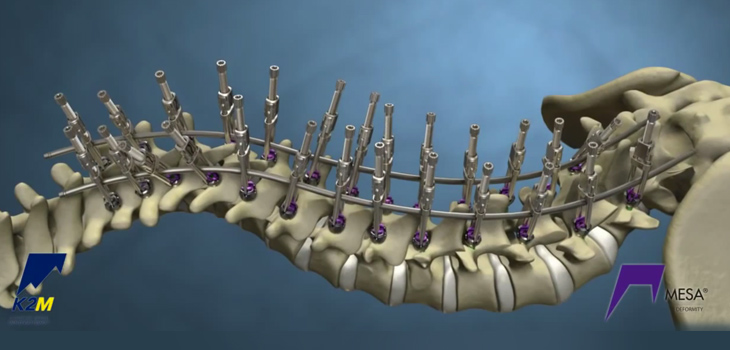
According to the company, application features of the MESA system include closed-head screws and previously cleared axial connectors, providing a surgical solution for patients less than 10 years of age to obtain and maintain correction of severe, progressive, life threatening, early-onset spinal deformities associated with thoracic insufficiency, including early-onset scoliosis.
With this additional spine application, the company says surgeons can “utilize components from a traditional fusion construct for a growth-enabling construction, allowing implants to be surgically lengthened on a periodic basis as the patient grows. This growing spine application also offers a growth guidance option, combining standard instrumentation and placement of unlocked closed-head screws at non-fusion levels, to allow for rod passage as the patient grows.”
The implants may be used with any cleared K2M rod construct ranging in diameter from 4.5 mm to 6.35 mm. K2M’s growth rod conversion implants may be used with 4.5 mm and 5.5 mm rod constructs.
Company President and CEO Eric Major said the regulatory milestone, “coupled with our recent data announcement of findings surrounding our motion-preserving scoliosis technology, reinforce our ongoing commitment to achieving the highest level of excellence in developing innovative technologies that provide enduring treatments for young patients suffering from complex spinal deformities, such as early-onset scoliosis and adolescent idiopathic scoliosis.”
In July, K2M announced findings from a multi-year study surrounding the company’s acquired motion-preserving scoliosis technology from K-Spine. The study, said the company, found that the innovative apical fusion technique achieved corrected deformity profiles in AIS (adolescent idiopathic scoliosis) patients and maintained mobility of non-fused segments with a lower implant density, sparing 52% of the spanned area from fusion.
The K-Spine technology is not yet available for sale in the U.S.
To watch a video of the MESA being implanted, click here.
Author
React:
Discussion
This is a fascinating development. In my practice we've seen similar outcomes with the revised protocol. The key differentiator seems to be patient selection criteria. Has anyone else noticed the correlation with BMI thresholds?
Great point. I'd push back slightly on the conclusion, the sample size in the cited study is too small to draw population-level inferences. That said, the directional signal is compelling and worth a larger RCT.
We implemented a similar approach last year. Early results are promising but we're still gathering 12-month follow-up data. Happy to share our protocol if anyone is interested.
Join the conversation
Orthopedic professionals are discussing this. Sign in and upgrade to read every comment and add your voice.