
While it’s a bit more complex than shop class, it may be possible to weld together flakes of graphene into solids that can be used for bone implants, say an international team of scientists led by researchers at Rice University.
Graphene Flakes=Bone Implants?
2 min read Premium comments
Secondary
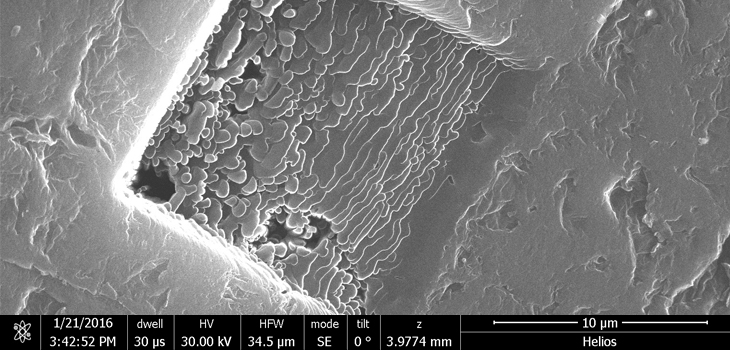
According to the September 2, 2016 news release, “The Rice lab of materials scientist Pulickel Ajayan and colleagues in Texas, Brazil and India used spark plasma sintering to weld flakes of graphene oxide into porous solids that compare favorably with the mechanical properties and biocompatibility of titanium, a standard bone-replacement material.”
“We started thinking about this for bone implants because graphene is one of the most intriguing materials with many possibilities and it’s generally biocompatible, ” said Rice postdoctoral research associate Chandra Sekhar Tiwary, co-lead author of the paper with Dibyendu Chakravarty of the International Advanced Research Center for Powder Metallurgy and New Materials in Hyderabad, India. “Four things are important: its mechanical properties, density, porosity and biocompatibility.”
As indicated in the news release, “The material they made is nearly 50% porous, with a density half that of graphite and a quarter of titanium metal. But it has enough compressive strength—40 megapascals—to qualify it for bone implants, ” Tiwary said. “The strength of the bonds between sheets keeps it from disintegrating in water.”
“With the help of colleagues at Hysitron in Minnesota, the researchers measured the load-bearing capacity of thin sheets of two- to five-layer bonded graphene by repeatedly stressing them with a picoindenter attached to a scanning electron microscope and found they were stable up to 70 micronewtons. Colleagues at the University of Texas MD Anderson Cancer Center successfully cultured cells on the material to show its biocompatibility. As a bonus, the researchers also discovered the sintering process has the ability to reduce graphene oxide flakes to pure bilayer graphene, which makes them stronger and more stable than graphene monolayers or graphene oxide.”
Tiwary told OTW, “2D materials (especially graphene) are reported to be the strongest materials. Due to recent research advancement we are able to make large scale 2D sheets. If we can interconnect these atomically thin sheets, it can result in a solid structure which can be explored for different applications.
“The current work is one of initial study which opens up a new possibility of exploration of graphene for bone replacement. Utilizing the atomically thin material can drastically help in bio applications. These require detailed exploration.”
Author
React:
Discussion
This is a fascinating development. In my practice we've seen similar outcomes with the revised protocol. The key differentiator seems to be patient selection criteria. Has anyone else noticed the correlation with BMI thresholds?
Great point. I'd push back slightly on the conclusion, the sample size in the cited study is too small to draw population-level inferences. That said, the directional signal is compelling and worth a larger RCT.
We implemented a similar approach last year. Early results are promising but we're still gathering 12-month follow-up data. Happy to share our protocol if anyone is interested.
Join the conversation
Orthopedic professionals are discussing this. Sign in and upgrade to read every comment and add your voice.