
Researchers from the University of California San Diego have found that if they feed adenosine (ATP), a molecule that occurs naturally in the body, to human pluripotent stem cells, they will regenerate bone tissue. Shyni Varghese, Ph.D. a bioengineering professor at UC San Diego was senior author of the study.
Feed Molecule to Stem Cells, Get Bone Regeneration
1 min read Premium comments
Secondary
According to the August 31, 2016 news release, “The stem-cell-derived bone tissue helped repair cranial bone defects in mice without developing tumors or causing infection. The work could lead to regenerative treatments for patients with critical bone defects and soldiers who have suffered traumatic bone injuries. The findings, published August 31 in the journal Science Advances, could also lead to a simple, scalable and inexpensive way to manufacture a pure population of bone-building cells.
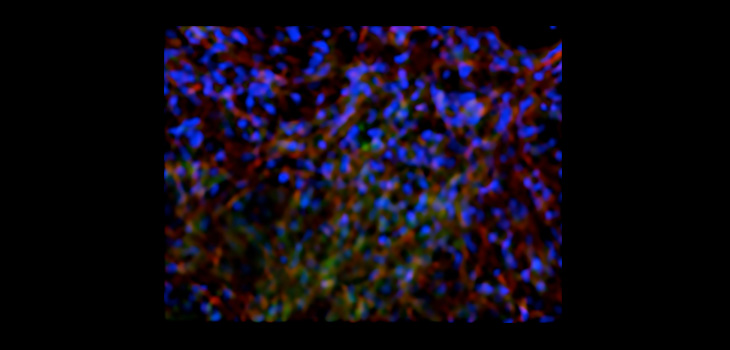
“Varghese and her team showed that they could control the differentiation of human pluripotent stem cells into functional osteoblasts—bone-building cells—simply by adding the molecule adenosine to their growth medium. Like living bone cells in the body, the resulting osteoblasts built bone tissues with blood vessels. When transplanted into mice with bone defects, the osteoblasts formed new bone tissues in vivo without any signs of teratoma formation.”
Dr. Varghese told OTW, “We are studying bone tissue formation and devising new methods to induce osteogenic differentiation of stem cells. This work stems from our previous study, which investigated how calcium phosphate minerals found in bone tissue induce stem cells to differentiate into osteoblasts. We have identified that stem cells take up calcium phosphate to produce ATP, a metabolic molecule, which then breaks down into adenosine and functions as an autocrine or paracrine molecule and signals the stem cells to become osteoblasts.
“Our study shows that adenosine can be used to derive large numbers of osteoblasts from hESCs [human embryonic stem cell] and hiPSCs [human induced pluripotent cell]. These hESC- and hiPSC-derived osteoblasts contribute to bone tissue formation and treat critical sized bone defects.”
React:
Discussion
This is a fascinating development. In my practice we've seen similar outcomes with the revised protocol. The key differentiator seems to be patient selection criteria. Has anyone else noticed the correlation with BMI thresholds?
Great point. I'd push back slightly on the conclusion, the sample size in the cited study is too small to draw population-level inferences. That said, the directional signal is compelling and worth a larger RCT.
We implemented a similar approach last year. Early results are promising but we're still gathering 12-month follow-up data. Happy to share our protocol if anyone is interested.
Join the conversation
Orthopedic professionals are discussing this. Sign in and upgrade to read every comment and add your voice.