
One-Year Anniversary for First Child to Undergo a Bilateral Hand Transplant
Child’s Bilateral Hand Transplant One Year Later; Mitochondria Important for Bone Formation?; Transiliac–Transsacral Screws=Unilateral Iliosacral Screw Fixation
5 min read Premium comments
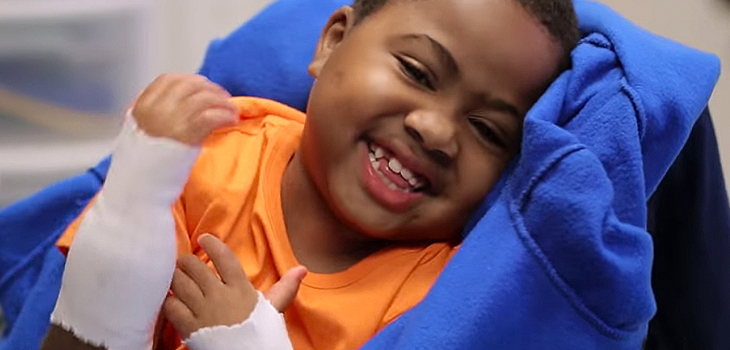
For most of his nine years on this earth Zion Harvey functioned without hands and feet. Young Zion had undergone an amputation of his hands and feet and a kidney transplant following a serious infection. Then last year, a team of specialists from The Children’s Hospital of Philadelphia (CHOP), Penn Medicine, and Shriners Hospitals for Children – Philadelphia, operated on Zion and successfully transplanted donor hands and forearms.
One year later, Zion can throw a baseball and a football, fix his own lunch, and write in his journal. This comes after spending up to eight hours a day in rehabilitation at Kennedy Krieger Institute, near his home in Baltimore. The team at CHOP will forever monitor Zion’s progress; indeed, he continues to receive daily immunosuppressant medications to prevent his body from rejecting the new limbs, as well as his transplanted kidney.
“He’s gaining independence and that is the whole reason why we do this, ” said L. Scott Levin, M.D., FACS, in the August 23, 2016 news release. Dr. Levin is chairman of the Department of Orthopaedic Surgery and a Professor of Plastic Surgery in the Perelman School of Medicine at the University of Pennsylvania, and Director of the Hand Transplantation Program at The Children’s Hospital of Philadelphia. “Zion’s remarkable progress would not have been possible without a large team of multidisciplinary specialists, and the foundational work our hand transplant team at Penn Medicine has built, starting with our first adult hand transplant in 2011.”
Dr. Levin told OTW, “Zion’s progress over the last year has been tremendously promising, not only in terms of his long term prognosis and quality of life, but also for future pediatric patients. The efforts of our collaborative team combined with the determination and drive that Zion has displayed has given us a baseline for what a successful pediatric bilateral hand transplant looks like. Now, we’re able to take what we have learned and apply it to future care plans for those patients that may come next.”
Mitochondria Important for Bone Formation?
Researchers in Philadelphia have deepened our understanding of calcium uptake and how that may affect bone healing. Specifically, the team from the Lewis Katz School of Medicine (LKSOM) at Temple University found that the functioning of a membrane known as the mitochondrial Ca2+ uniporter (MCU) can help us comprehend the pathologies associated with bone mineralization.
Muniswamy Madesh, Ph.D., Professor in the Center for Translational Medicine and the Department of Medical Genetics and Molecular Biochemistry at LKSOM, told OTW “When I was at my infancy stages in mitochondrial research, I used to hear very commonly that mitochondria are not only biological engines for energy production but also function as sponges for many metabolites and metal ions mainly calcium (Ca2+) and phosphate. Since then my laboratory has been passionately pursuing on identifying the molecular components that drive mitochondrial Ca2+ ion sequestration and efflux.
“In recent years, we have identified several proteins that participate in mitochondrial Ca2+ and phosphate uptake pathways that is a requisite for tricalcium phosphate (hydroxyapatite; bone apatite) precipitation. Our new findings speculate that mitochondria could play a vital role in bone formation besides other evolutionarily conserved biological functions.
“Mitochondrial calcium accumulation has three major phases. (1) Activation of respiratory enzymes, (2) buffer cellular calcium and (3) induce cell death. It is greatly believed that the relationships between these phases depend on free and total matrix calcium and phosphate concentration. It is also known that increasing mitochondrial phosphate decreased the free mitochondrial calcium, and the soluble amorphous Ca3(PO4)2 play a major role in maintaining the low matrix free calcium concentration with no bioenergetic demand.
“The precise role of mediating bone apatite formation remains largely unknown. Since 1970, some speculations have been put forward that calcium phosphate produced in the osteoblast mitochondria as granules could be delivered to vesicles that transported extracellularly for mineralization. As we all know mineralization is a common process in the animal kingdom and is fundamental to human development and health, aberrant mineralization could lead to several medical problems. In this scenario, it is important to understand that since mitochondria buffers and stores calcium, mitochondria can be highlighted as a component to maintain relationship between intracellular Ca3(PO4)2 and their mineralization in the extracellular matrix. This deciphers mitochondria for the normal bone formation and pathologies associated with mineralization.
“Our discovery highlights the important relationship between intracellular in particular mitochondrial calcium phosphate in bone-derived cells and their role in mineralizing the extracellular matrix on which apatite crystals subsequently form. Deciphering the role of mitochondrial Ca2+ uniporter (MCU) where Ca2+ enters the mitochondria may have important implications in how normal bone forms and that could aid further understanding of the pathologies associated with mineralization.
“For instance, it has been coded that 70% of the total bone mineral in young animals is amorphous phase calcium phosphate which is more labile but it declines with age to as little as 36%. It is tempting to further speculate that mitochondrial function could be compromised in the later stage of the human life that could impact the healing process of bone fracture. I am also pleased that our findings will have major impact in the human mankind in near future.”
Transiliac–Transsacral Screws=Unilateral Iliosacral Screw Fixation
When put head-to-head in a recent retrospective study, transiliac-transsacral and unilateral iliosacral screws came out as equal when it came to patients with unilateral posterior pelvic ring injuries.
The research took place at three level 1 trauma centers—Washington University in St. Louis, Stanford University School of Medicine, the University of Utah—and involved 866 surgical patients. Of those, 36 individuals treated with transiliac-transsacral screws and 26 who received unilateral iliosacral screws ended up meeting the inclusion criteria and participating.
Along with his colleagues, Michael J. Gardner, M.D., chief of the Orthopaedic Trauma Service at Stanford, set out to evaluate both pain and functional outcomes in these patients. Dr. Gardner told OTW, “Transiliac screws are being used more frequently at many centers to empower posterior pelvic fixation for highly unstable pelvic fractures. These work by anchoring in stronger cortical bone at the contralateral ilium after passing through the sacrum. The downside is that the contralateral, presumably healthy sacroiliac joint. We wanted to determine what the effect was of perforating this immobile joint with a screw.
“These screws can be technically difficult to safely place, and must be placed very precisely with triplanar fluoroscopy. But when inserted safely, they are very effective mechanically and appear to have minimal effects on the sacroiliac joint. I think surgeons can now confidently use these screws to maximize fixation strength for unstable sacral fractures without concern of long lasting effects to the contralateral sacroiliac joint.
“When these patients come back to the clinic, I always ask about contralateral pelvic symptoms to see if there are any issues potentially related to the presence of the screw. Anecdotally, it is very rare to have a patient complain of contralateral pain, so it is nice to have some validated research to confirm this observation.”
React:
Discussion
This is a fascinating development. In my practice we've seen similar outcomes with the revised protocol. The key differentiator seems to be patient selection criteria. Has anyone else noticed the correlation with BMI thresholds?
Great point. I'd push back slightly on the conclusion, the sample size in the cited study is too small to draw population-level inferences. That said, the directional signal is compelling and worth a larger RCT.
We implemented a similar approach last year. Early results are promising but we're still gathering 12-month follow-up data. Happy to share our protocol if anyone is interested.
Join the conversation
Orthopedic professionals are discussing this. Sign in and upgrade to read every comment and add your voice.