
The American Joint Replacement Registry (AJRR), an organization that collects data and uses it to improve outcomes of primary and revision hip and knee replacement procedures, is announcing its updated web portal.
AJRR Ramps Up Web Portal
2 min read Premium comments
Secondary
“Our web portal isn’t static, ” said Daniel J. Berry, M.D., chair of the AJRR Board of Directors. “Our collaboration with AOA [the American Orthopaedic Association] and AAHKS [the American Association of Hip and Knee Surgeons] this year adds extra measures, bringing our total to 38 PQRS [Physician Quality Reporting System] and custom measures. We are excited to provide a more comprehensive platform that appeals to the specific needs of our participating surgeons.”
As indicated in the September 6, 2016 news release, “AOA’s quality improvement program Own the Bone supports the expansion of the platform by including two additional PQRS post-fracture measures. The AAHKS partnership adds four additional custom measures documenting process and outcomes for hip arthroplasty patients.”
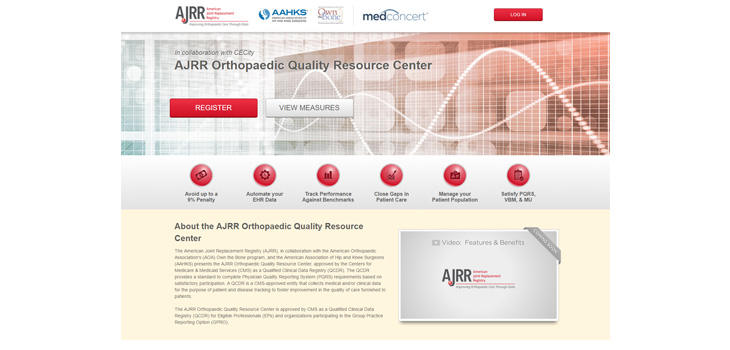
“The National Registry provides PQRS and Meaningful Use assistance in the form the AJRR Orthopaedic Quality Resource Center, which is made possible by partnering with CECity, a Premier Inc. Company, healthcare’s leading provider of cloud-based registry platforms for performance improvement, value-based payment, and professionalism. The Orthopaedic Quality Resource Center gives EPs a way to report their Medicare patients to CMS. At the same time, EPs receive timely, continuous performance monitors, targeted education, access to patient care management tools, Registry benchmarks, performance gap analysis and patient outlier identification, and various resources used to close performance gaps.”
Dr. Berry told OTW, “The Orthopaedic Quality Resource Center now includes measures for post-fracture care coordination and osteoporosis management, supporting Own the Bone’s goal to better identify, evaluate, and treat patients that suffer from an osteoporosis or low bone density-related fracture. In addition to offering more PQRS measures, 2016 reporting also allows for Group Practice Reporting Option (GPRO) for PQRS. Multiple eligible professionals will be able to be analyzed under a single Tax Identification Number (TIN).”
Kyle J. Jeray, M.D., Chair of The American Orthopaedic Association’s Own the Bone Steering Committee, told OTW, “The American Orthopaedic Association was very happy to support the addition of two post-fracture PQRS measures to the 2016 AJRR Orthopaedic Quality Resource Center QCDR for participating surgeons to document and improve their bone health management of fragility fracture patients. These measures are critical in reducing the number of geriatric fracture hospitalizations, and particularly the number of debilitating hip fracture admissions.”
React:
Discussion
This is a fascinating development. In my practice we've seen similar outcomes with the revised protocol. The key differentiator seems to be patient selection criteria. Has anyone else noticed the correlation with BMI thresholds?
Great point. I'd push back slightly on the conclusion, the sample size in the cited study is too small to draw population-level inferences. That said, the directional signal is compelling and worth a larger RCT.
We implemented a similar approach last year. Early results are promising but we're still gathering 12-month follow-up data. Happy to share our protocol if anyone is interested.
Join the conversation
Orthopedic professionals are discussing this. Sign in and upgrade to read every comment and add your voice.