
Orthofix International N.V.’s Trinity Evolution bone graft showed 93.5% fusion rates at 12 months and 78.6% at six months in a 12-month study of patients who underwent single-level anterior cervical discectomy and fusion (ACDF) in combination with a PEEK interbody spacer and supplemental anterior fixation.
Trinity Bone Graft Shows 93.5% Fusion Rate in High Risk Patients
2 min read Premium comments
Secondary
On July 27, 2016, the company announced the publication of the study in the European Spine Journal. Seventy-five percent of the study participants were current or former smokers, diabetic, overweight, obese or extremely obese and considered to be at high risk for bone growth failure.
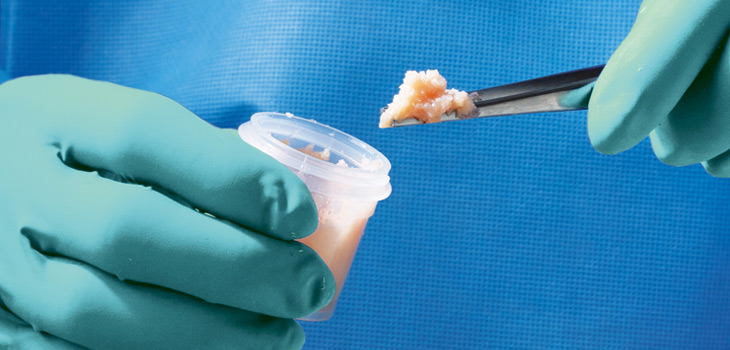
Trinity is a cryopreserved allograft consisting of cancellous bone with, according to the company, “viable cells retained within that matrix and a demineralized cortical bone component. It possesses all three of the key properties for successful bone grafting, which makes it an ideal autograft substitute.”
Timothy A. Peppers, M.D., at Scripps Hospital and a co-author of the journal article, said, “This study demonstrated the effectiveness of Trinity Evolution in achieving a solid fusion when used in this manner, indicating that it is a viable option for patients needing anterior cervical discectomy and fusion.”
The prospective, multi-center, clinical study was designed to evaluate the effectiveness of Trinity Evolution, “a viable cellular bone allograft” in patients undergoing a single level fusion at the vertebral locations between C3/C4 and C6/C7. The allograft was placed within and around each Orthofix PEEK interbody spacer to promote bone growth.
The primary endpoint was radiographic fusion status based on independent review of CT scans and radiographic review of angular motion. The criteria for fusion was the presence of bridging bone across the adjacent endplates as seen on thin cut CT scans in addition to angular motion from flexion/extension X-rays.
In addition, secondary endpoints were measured including function as assessed by the Neck Disability Index and neck and arm pain as assessed by individual Visual Analog Scales (VAS). Neck function and neck/arm pain were found to significantly improve at both 6 and 12 months. There were no serious adverse events attributable to Trinity Evolution as determined by an independent consultant.
Orthofix Chief Scientific Officer James Ryaby, Ph.D., said the results are important “as they further substantiate that Trinity Evolution is effective even in challenging patient populations who might not respond well to traditional allograft and autograft materials.”
The allograft, processed by the nonprofit tissue provider, the Musculoskeletal Transplant Foundation (MTF), is the predecessor of Trinity ELITE, a moldable bone graft material that enables physicians to control the placement of tissue during procedures. To date there have been more than 150, 000 procedures using Trinity Evolution and Trinity ELITE, according to the company.
Author
React:
Discussion
This is a fascinating development. In my practice we've seen similar outcomes with the revised protocol. The key differentiator seems to be patient selection criteria. Has anyone else noticed the correlation with BMI thresholds?
Great point. I'd push back slightly on the conclusion, the sample size in the cited study is too small to draw population-level inferences. That said, the directional signal is compelling and worth a larger RCT.
We implemented a similar approach last year. Early results are promising but we're still gathering 12-month follow-up data. Happy to share our protocol if anyone is interested.
Join the conversation
Orthopedic professionals are discussing this. Sign in and upgrade to read every comment and add your voice.