
If bone grafts work in pigs, will people be next?
Stem Cell Laced Grafts Grow Bone in Pigs
2 min read Premium comments
Secondary
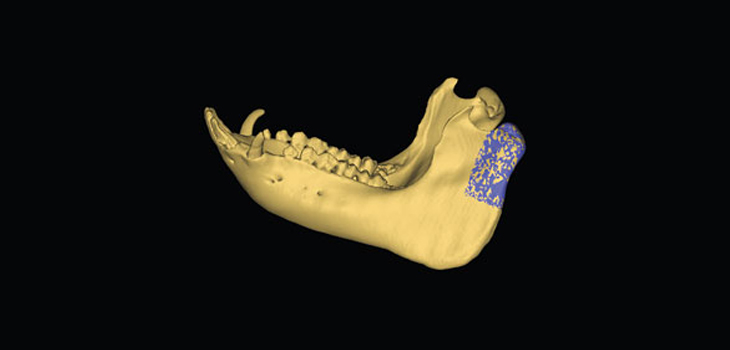
According to Science Daily, researchers from Columbia University, New York, engineered living bone tissue to repair bone loss in the jaws of pigs. The custom implants resulted in integration of the graft into the recipient pig’s own tissue.
Researchers chose pigs on which to test the new bone reconstruction technique because pig’s jaw anatomy and movement are similar to that of people. For their test they replaced a piece of the pigs’ jawbone with cow bone matrix which served as a scaffold for a graft. The researchers individually shaped each cow bone scaffold to fit perfectly into the pig’s missing jaw-bone region.
They then seeded the scaffold with the pig’s own stem cells harvested from the animals’ fat. They placed the engineered tissue inside a bioreactor to grow for three weeks before implanting the bone grafts into the pigs. The transplanted bone seamlessly integrated into the pigs’ jaws. The grafts both prompted new bone growth and strengthened the bone enough that the pigs were able to chew.
The researchers found that the pig’s body reacted to the implant just as if the implant were its own bone, breaking it down and rebuilding it as needed. “This was an unexpected and also very exciting finding because it tells us that these bones will really become an integral part of the body and continue to change in the body as we change, ” said Gordana Vunjak-Novakovic, Ph.D., a professor of biomedical engineering and medical sciences at Columbia University and the senior author of the paper. “It’s important that the implant is responding to these changes, and acting as an integral part of the native bone of the recipient.”
Six pigs received engineered implants. Six received the cow bone without any stem cells and two jaw-bone deficient pigs received no implant at all. At the six-month point, all the animals showed some regrowth of the missing jaw. Those pigs that had received the engineered implant grew the most bone.
Although the team was working on pigs, they performed the procedures on the animals as if they were human subjects. All are hopeful that it will soon be able to be done in clinics on humans. “It’s never possible to say exactly, but we are aiming to get into clinical trials within the next few years, ” said Vunjak-Novakovic. “Hopefully things continue to go well.”
Author
React:
Discussion
This is a fascinating development. In my practice we've seen similar outcomes with the revised protocol. The key differentiator seems to be patient selection criteria. Has anyone else noticed the correlation with BMI thresholds?
Great point. I'd push back slightly on the conclusion, the sample size in the cited study is too small to draw population-level inferences. That said, the directional signal is compelling and worth a larger RCT.
We implemented a similar approach last year. Early results are promising but we're still gathering 12-month follow-up data. Happy to share our protocol if anyone is interested.
Join the conversation
Orthopedic professionals are discussing this. Sign in and upgrade to read every comment and add your voice.