
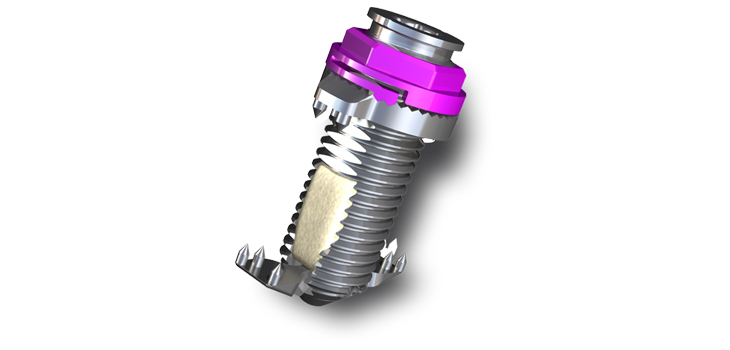
Spinal Simplicity, LLC, a medical device company in Overland Park, Kansas, is launching a new generation of its Minuteman G3 fusion device that features an FDA-cleared coating of hydroxyapatite (HA).
Spinal Simplicity Launches New Spinal Fusion Device
1 min read Premium comments
Secondary
“HA, also known as a ‘bone mineral’, has been used in orthopedic procedures for the last 30 years because of its successful track record, ” said Todd Moseley, CEO and co-founder of Spinal Simplicity. He said that the mineral is naturally occurring in human teeth and bones and can be successfully synthesized.
According to officials at Spinal Simplicity, the reason HA coated devices have not been adopted into more procedures is because they had not been packaged into the form of sterile implants.
Jonathan Hess, vice president of business development, explained. “For companies to try to accomplish what we’re doing retrospectively, they’d have to seek new clearances from the FDA. By switching to sterile pack processing they’d have to start over with new inventory, requiring excessive time and money. With Spinal Simplicity integrating a sterile packed implant since its inception, we are able to offer a better solution to our customer surgeons and their patients.”
After Spinal Simplicity’s launching of the Minuteman G3 implant device with HA coating, several industry leading surgeons have worked with the product. Among them are Omar Osmani, M.D., from New Mexico, Elizabeth Trinidad, M.D., from Florida, Larry Khoo, M.D., from California, and Randolph Bishop, M.D., from Georgia. Each physician successfully implanted the HA Minuteman G3 in April and May of this year.
Author
React:
Discussion
This is a fascinating development. In my practice we've seen similar outcomes with the revised protocol. The key differentiator seems to be patient selection criteria. Has anyone else noticed the correlation with BMI thresholds?
Great point. I'd push back slightly on the conclusion, the sample size in the cited study is too small to draw population-level inferences. That said, the directional signal is compelling and worth a larger RCT.
We implemented a similar approach last year. Early results are promising but we're still gathering 12-month follow-up data. Happy to share our protocol if anyone is interested.
Join the conversation
Orthopedic professionals are discussing this. Sign in and upgrade to read every comment and add your voice.