
OrthoPediatrics Corp. has launched its new BandLoc 5.5/6.0mm System (BandLoc), a device which has already received both CE marking and FDA clearance and specific international markets. According to the August 16, 2016 company news release, “BandLoc is a pedicle-sparing, band passage technique for treating a wide variety of complex spinal pathologies, including scoliosis. The implant features a unique, pre-assembled design, which incorporates the Company’s RESPONSE set screw technology and accepts multiple rod diameters in Cobalt Chrome or Titanium. BandLoc also includes innovative and ergonomic instrumentation. While BandLoc incorporates the Company’s RESPONSE Spine System, it is compatible with any 5.5 or 6.0mm spinal correction system on the market and thus can be used in conjunction with competitive systems.”
OrthoPediatrics Rolls Out BandLoc System
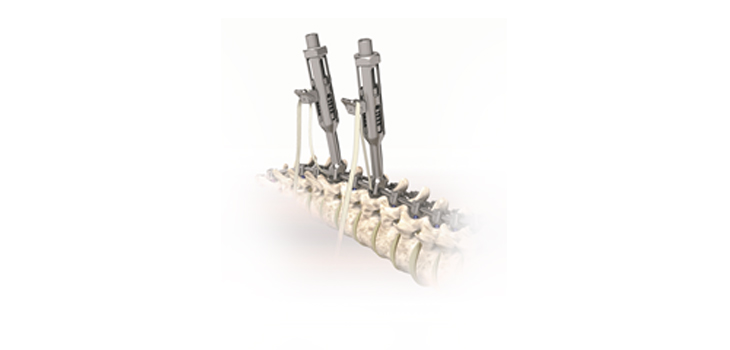
Jeff Smithey, OrthoPediatrics’ vice president of spine, said “We are excited to offer the BandLoc System, which was developed with pediatric orthopedic surgeons to provide another option for their pediatric patients in treating complex spinal deformities. This innovative technology expands our RESPONSE Spine portfolio and further represents our commitment as the only company completely focused on providing comprehensive, high quality solutions for pediatric orthopedic patients.”
Dayton, Ohio-based Pediatric Orthopedic Surgeon Mike Albert, M.D., who collaborated with the company on the design of BandLoc, said, “The BandLoc System is a great addition to the OrthoPediatrics RESPONSE system. Utilizing sub-laminar polyester bands and intuitive instrumentation, this system allows me to correct complex pediatric spinal deformities.”
David Bailey, executive vice president of OrthoPediatrics, told OTW, “Sub-laminar banding is an exciting and fast-growing technology in the global spine market. We are excited at the potential our BandLoc system brings to surgeons who are looking for new and innovative technologies to treat complex, spinal deformity. Our system was designed in partnership with key opinion leaders, and is compatible with the OP RESPONSE dual-rod system, or competitive 5.5/6.0mm systems, giving surgeons increased intra-operative flexibility.”
Discussion
This is a fascinating development. In my practice we've seen similar outcomes with the revised protocol. The key differentiator seems to be patient selection criteria. Has anyone else noticed the correlation with BMI thresholds?
Great point. I'd push back slightly on the conclusion, the sample size in the cited study is too small to draw population-level inferences. That said, the directional signal is compelling and worth a larger RCT.
We implemented a similar approach last year. Early results are promising but we're still gathering 12-month follow-up data. Happy to share our protocol if anyone is interested.
Join the conversation
Orthopedic professionals are discussing this. Sign in and upgrade to read every comment and add your voice.