
Toned, smoothly functioning muscles are the tools and weapons of professional sports. The Kansas City Royals, in a move to focus more attention and care on its players muscles, has formed a partnership with MuscleSound to improve the performance of its players and reduce the risk of injury to muscles.
Kansas City Royals Choose MuscleSound to Track Healing Rates
2 min read Premium comments
Secondary
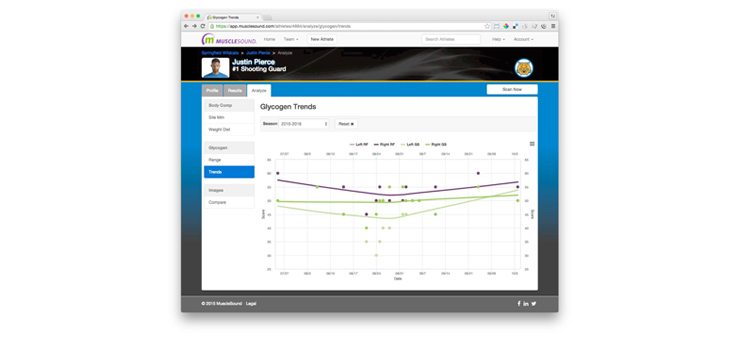
Based in Denver, Colorado, MuscleSound utilizes a unique, non-invasive process that measures the capacity of a muscle to generate, store, and replenish energy. That energy is in the form of glycogen. MuscleSound operates a cloud-based software program that generates easy-to-read reports on real-time muscle glycogen data based upon ultrasound images taken of each athlete. The program allows coaches and trainers to measure muscle glycogen levels pre and post performance using portable high-frequency ultrasound technology.
Company officials note that, until recently, muscle glycogen content levels could only be measured through invasive and often painful procedures such as muscle biopsy or through an MRI. They claim that, ”MuscleSound is the only company that delivers both pre and post-performance data in real time—even in the locker room.”
The instantaneous nature of the data retrieval enables trainers to make immediate, personalized nutritional and performance-based recommendations to athletes to guide their muscle recovery and injury prevention. The company notes that MuscleSound scans can also indicate signs and symptoms of muscle fatigue, overtraining and possible muscle damage.
Nick Kenney, head athletic trainer of the Kansas City Royals, said, “With MuscleSound we are able to take the guesswork out of the fueling and recovery process. The technology allows us to measure glycogen levels in seconds and assess injury risk by finding indications of overtraining and possible muscle damage. With that data, we then develop a customized nutritional and training plan for every player to ensure positive change in performance and injury reduction, and minimize recovery or time not playing due to injuries.”
“We are thrilled to work with the reigning world championship team, Kansas City Royals, ” said MuscleSound Chairman Stephen Kurtz. “By enabling the team to understand the nutritional needs of each player in real-time, they not only maximize the ROI [return on investment] of nutritional plans, but also of the players. We are confident that with MuscleSound, the Royals will see notable results in injury reduction and optimized performance.”
The Royals are not the only team that is working with MuscleSound. The company’s roster includes the Colorado Rockies, Los Angeles Rams and Dallas Mavericks, among others.
Author
React:
Discussion
This is a fascinating development. In my practice we've seen similar outcomes with the revised protocol. The key differentiator seems to be patient selection criteria. Has anyone else noticed the correlation with BMI thresholds?
Great point. I'd push back slightly on the conclusion, the sample size in the cited study is too small to draw population-level inferences. That said, the directional signal is compelling and worth a larger RCT.
We implemented a similar approach last year. Early results are promising but we're still gathering 12-month follow-up data. Happy to share our protocol if anyone is interested.
Join the conversation
Orthopedic professionals are discussing this. Sign in and upgrade to read every comment and add your voice.