
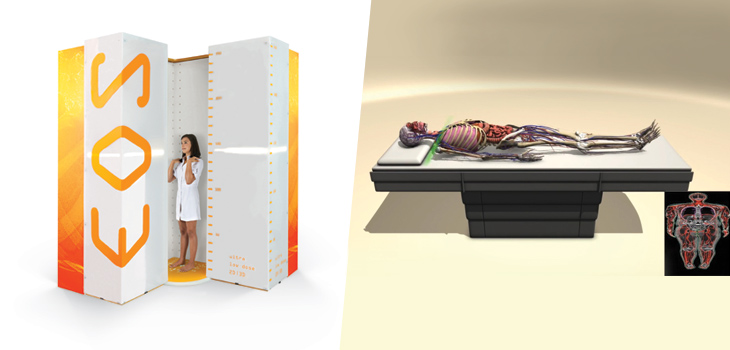
EOS imaging has signed an exclusive partnership with Anatoscope of Montpellier, France, to combine Anatoscope’s virtual patient models with EOS 2D/3D images and datasets into the EOS apps for advanced orthopedic applications. Look for the initial applications in 2017.
Imaging Avatars: EOS Partners With Anatoscope
1 min read Premium comments
Secondary
As indicated in the July 21, 2016 news release, “Anatoscope, a start-up company created in 2015, develops software solutions to generate 3D digital avatars that are based on a patient’s medical images which allow the simulation of medical treatments. The team has robust experience in developing patient models from CT scans and MR images.”
“The exclusive agreement and associated licensing rights cover the development of patient avatars from EOS 2D/3D images and datasets as well as their deformation. Initially, the model will take into account the patient corpulence and external body shape in combination with the patient’s skeletal images from their EOS exam…”
Marie Meynadier, Ph.D., CEO of EOS imaging, said, “Introducing a virtual patient model into our advanced 3D orthopedic applications will assist surgeons as they plan their patient’s spine treatments. The Anatoscope agreement complements the ongoing internal developments with our partner Spinologics [Inc.] to bring within our EOSapps the most cost-effective and relevant solutions to image-based planning, simulation and control of orthopedic therapies.”
Dr. Meynadier told OTW, “Surgeons today place strong emphasis on ensuring surgery restores the patient’s optimal alignment to minimize the strain on the skeletal system, particularly on the spine. In doing so, the patient is looked at as a skeleton, and the impact of the corpulence is neglected, even though there is a strong possibility that it will impact the long-term outcome of the surgery. With this technology, we will introduce patient avatars with morphorealistic corpulence, created from just two EOS low dose images, to answer surgeons’ demand for the planning of more robust spine surgeries.”
Author
React:
Discussion
This is a fascinating development. In my practice we've seen similar outcomes with the revised protocol. The key differentiator seems to be patient selection criteria. Has anyone else noticed the correlation with BMI thresholds?
Great point. I'd push back slightly on the conclusion, the sample size in the cited study is too small to draw population-level inferences. That said, the directional signal is compelling and worth a larger RCT.
We implemented a similar approach last year. Early results are promising but we're still gathering 12-month follow-up data. Happy to share our protocol if anyone is interested.
Join the conversation
Orthopedic professionals are discussing this. Sign in and upgrade to read every comment and add your voice.