
With the recent announcement by Conventus Orthopaedics, Inc. that it has received 510(k) clearance from the FDA to market its new Conventus Cage DU (Distal Ulna) and PU (Proximal Ulna) Systems, patients with ulnar fractures now have, shall we say, an expansion of options.
Conventus: 510(k) for Ulna Systems
2 min read Premium comments
Secondary
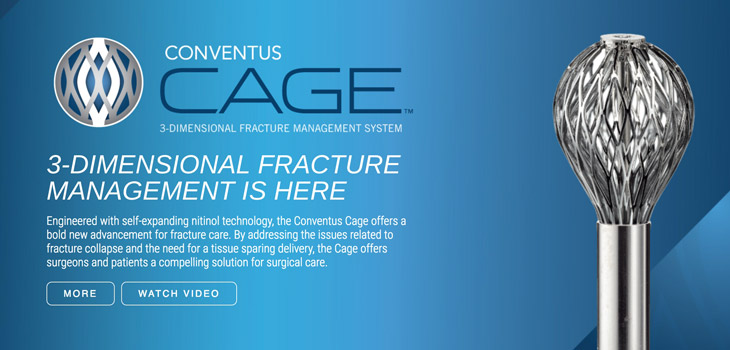
As indicated in the August 15, 2016 news release, “Utilizing the shape memory properties of nitinol, the Conventus Cage expands within the bone creating robust, stable fixation and thus prevents collapse of the fracture repair. Similar to the company’s first three products, and aligned with the company’s principles of 3-dimensional design, these new Conventus Cages create rigid substrates designed to self-expand within the bone to avoid interference with soft tissues. The self-expanding scaffolds provide options to achieve reliable and less invasive repairs while potentially eliminating the need for a second surgery when compared with alternative options…. Conventus’ 3-dimensional Cage platform technology, emphasizes preservation of tissues and blood supply at the fracture site, creating a strong foundation by stabilizing bone fragments and facilitating early motion through less invasive procedures.”
Conventus President and CEO Paul Buckman said, “The approval of this additional indication reflects our commitment to provide more innovative solutions and options for surgeons working to repair orthopedic fractures throughout the body. Our overall goal is to provide a complete platform technology enabling surgeons to treat all trauma and fracture repairs from a 3-dimensional approach.”
Paul Paterson, M.D. of Excelsior Orthopaedics, Buffalo, New York, said, “Plate fixation of the distal ulna is not an easy fix due to the size of the bone. The Conventus Cage DU offers tremendous stability of the fracture—better than plates and screws—and decreased recovery time due to the minimally invasive technique.”
Andrew Palmer, M.D. added, “There is a definite benefit to the Conventus devices that are implanted into the bone. It eliminates the potential for interference of plates, screws or tension band wiring as well as the need for a second surgery to remove fixation.”
Paul Buckman told OTW, “In our initial phase of commercialization that is currently underway, the feedback from the surgeons has been overwhelmingly positive. They quickly realize the potential advantages of our unique three dimensional scaffolding technology, and they have been pleasantly surprised at being able to utilize our devices in various upper extremity periarticular fractures.
“The Conventus Cage technology will expand what is possible in patient care by enabling surgeons to repair a wider variety of fractures through less invasive means. We believe this is another important building block in our technology platform and has the potential to transform fracture repair management.”
React:
Discussion
This is a fascinating development. In my practice we've seen similar outcomes with the revised protocol. The key differentiator seems to be patient selection criteria. Has anyone else noticed the correlation with BMI thresholds?
Great point. I'd push back slightly on the conclusion, the sample size in the cited study is too small to draw population-level inferences. That said, the directional signal is compelling and worth a larger RCT.
We implemented a similar approach last year. Early results are promising but we're still gathering 12-month follow-up data. Happy to share our protocol if anyone is interested.
Join the conversation
Orthopedic professionals are discussing this. Sign in and upgrade to read every comment and add your voice.