
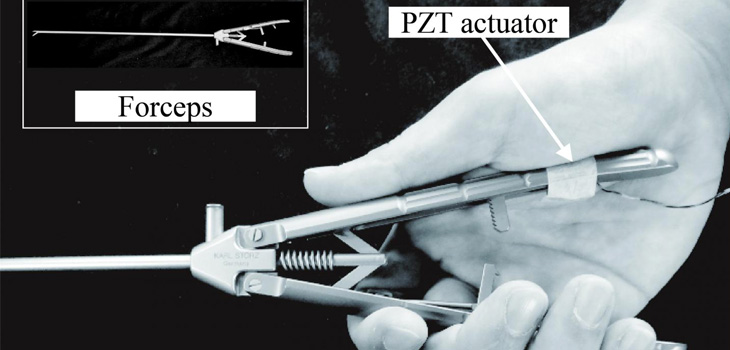
Japanese researchers have created a vibrating device that can be added to surgical tools could improve surgeons’ sensitivity to different shapes and textures inside their patients’ bodies. The engineers, from Hiroshima University, have designed the small vibrating device that can be used right away and does not require additional training. The vibrations—say the researchers—are so subtle that they do not shake the tool.
Better Surgery Through Vibration
2 min read Premium comments
Secondary
“We started this work six years ago, trying to enhance human fingertip sensitivity, but in 2012 I had the idea that increased sensitivity could be valuable during minimally invasive surgeries. Typical medical tools obtain information about the patient’s condition. There are very few devices that aim to enhance the doctor’s skill, ” said Yuichi Kurita, Ph.D., lead author of the study and associate professor at Hiroshima University, in the August 1, 2016 news release.
“The vibrator, called PZT Actuator, attaches to a surgeon’s favorite surgical tool and vibrates in the surgeon’s palm at a constant rate. The vibrations are so subtle they cannot be sensed. However, this constant, uniform vibration enhances the surgeon’s sensitivity to other, irregular sensations. The natural variations of touching different tissues with a metal tool may normally be too subtle for the surgeon to detect, but the constant vibrations supplied by the PZT Actuator boost the sensation to a noticeable level.”
“Volunteers were blindfolded and asked to use surgical forceps with the PZT Actuator attached to the handle to identify different textures of sandpaper and find a small Styrofoam ball inside a cup filled with silicone. These tests mimic detecting tissue texture and identifying a solid tumor.”
“The results of these tests and other analysis revealed that there is a range of vibration intensity that significantly improves anyone’s sensitivity. The tool does not need to be fine-tuned to each user’s unique sense of touch, meaning the PZT Actuator should be robust and simple to use.”
“Researchers first tested the device through mathematical modeling using calculations of four types [of] neurons and their response to different levels of mechanical stimulation. The mathematical term describing the phenomena of a constant undetectable signal enhancing a simultaneous irregular signal is called the stochastic resonance effect.”
Dr. Kurita told OTW, “Our technique enables surgeons to find very small difference in tactile feeling of body organs. Although our article was done for a medical device of laparoscopic surgery, the basic idea can be applied for any kinds of medical devices that require surgeons nuanced tactile information to use, including orthopedic surgery.”
“The optimal noise to be added depends on the situation. Measuring the actual stimuli given from the surgical forceps during a surgery could be useful to tune the device. The practical design is also needed to keep the functional requirements for a surgical tool, such as: 1) safety, 2) hygiene, 3) not disturbing operations, and 4) ease of use.”
React:
Discussion
This is a fascinating development. In my practice we've seen similar outcomes with the revised protocol. The key differentiator seems to be patient selection criteria. Has anyone else noticed the correlation with BMI thresholds?
Great point. I'd push back slightly on the conclusion, the sample size in the cited study is too small to draw population-level inferences. That said, the directional signal is compelling and worth a larger RCT.
We implemented a similar approach last year. Early results are promising but we're still gathering 12-month follow-up data. Happy to share our protocol if anyone is interested.
Join the conversation
Orthopedic professionals are discussing this. Sign in and upgrade to read every comment and add your voice.