
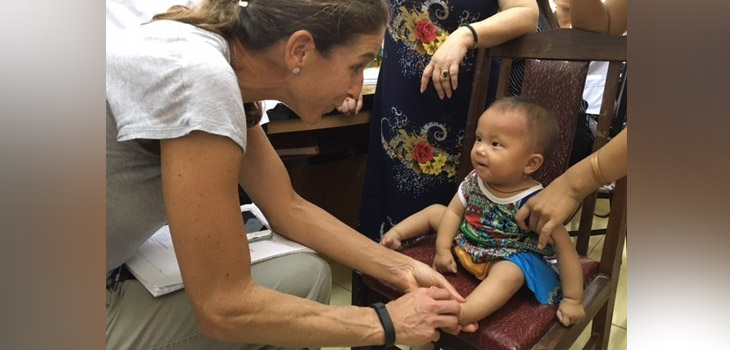
A group of volunteers from the American Orthopaedic Foot & Ankle Society (AOFAS) recently returned to Vietnam, where they not only performed surgery, but participated in educational programs.
AOFAS Volunteers Help Out in Vietnam
2 min read Premium comments
Secondary
According to the July 29, 2016 news release, “This year’s volunteer group evaluated 218 patients in clinics and performed surgery on 66, all at no cost to the patients. Since the first AOFAS Overseas Outreach Project to Vietnam in 2002, more than 1, 300 patients have benefited from surgery performed without charge by AOFAS volunteers, and more than 3, 000 patients have been seen in the clinics. Most patients are from impoverished areas and lack access to care. Others are unable to afford advanced medical services.”
“While I knew I would see some unusual cases, I was still surprised by the level of deformity and the children’s will to overcome their disabilities, ” said Robert Mihalich, M.D., of Brighton, Michigan. “Most of the patients we saw were just looking for help and grateful for whatever we could do. I returned home with a renewed sense of purpose and improved perspective on what it means to take care of patients.”
“Most of the surgeries we performed involved complications of clubfoot and cerebral palsy, ” said A. Holly Johnson, M.D., who practices in Boston. “The patients were amazingly resilient and brave, and we felt lucky to have the opportunity to offer them our care. We also enjoyed teaching the local surgeons diagnosis and treatment algorithms for different foot and ankle problems.”
“During the multi-week project, which ended in mid-June, the volunteers worked at orthopedic rehab centers and taught residents. In addition to Johnson and Mihalich, volunteer surgeons included Naomi Shields, M.D., of Wichita, Kansas, and Raymond J. Sullivan, M.D., of Hartford, Connecticut, ” said the news release.
“Education is an important part of the outreach project, and the AOFAS volunteers presented at the annual conference on Surgery of the Lower Extremity held on June 11 in Hanoi. Co-sponsored by the AOFAS, MOI, the Vietnam Ministry of Health and Viet Duc University Hospital, the conference utilized simultaneous translation and was attended by 120 Vietnamese orthopedic surgeons. The program included presentations by four Vietnamese surgeons. The AOFAS volunteers also presented at smaller seminars in the hospitals where they worked.”
Asked about an interesting clinical moment, Dr. Mihalich told OTW, “The most interesting moment for me clinically was seeing children with significant deformities who have managed to function for years. To be able to correct the deformity and change that child’s life hopefully for the better was very rewarding. Personally, I found the people of Vietnam very friendly and welcoming to our team. I felt very comfortable despite the language barrier and enjoyed teaching the Vietnamese surgeons.”
“Programs like the Vietnam Outreach with AOFAS exist and allow us to travel to interesting parts of the world and see a culture that you might otherwise never see. This program allowed me to focus on caring for patients rather than the other bureaucratic details that plague our practices in the U.S. I was able to truly make a difference in some people’s lives.”
React:
Discussion
This is a fascinating development. In my practice we've seen similar outcomes with the revised protocol. The key differentiator seems to be patient selection criteria. Has anyone else noticed the correlation with BMI thresholds?
Great point. I'd push back slightly on the conclusion, the sample size in the cited study is too small to draw population-level inferences. That said, the directional signal is compelling and worth a larger RCT.
We implemented a similar approach last year. Early results are promising but we're still gathering 12-month follow-up data. Happy to share our protocol if anyone is interested.
Join the conversation
Orthopedic professionals are discussing this. Sign in and upgrade to read every comment and add your voice.