
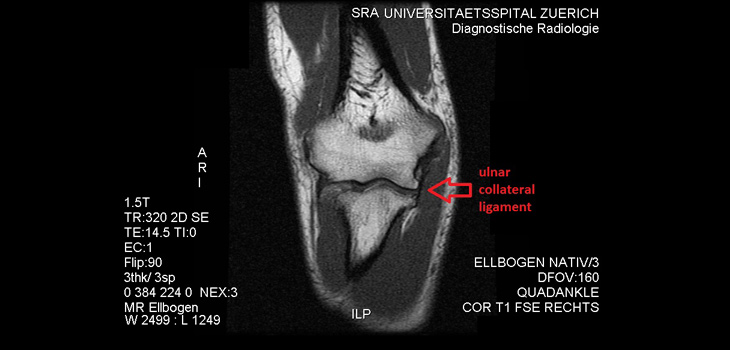
Exactly where an ulnar collateral ligament (UCL) tear is located makes a difference, says new work presented at the 2016 American Orthopaedic Society for Sports Medicine’s (AOSSM) Annual Meeting in Colorado Springs, Colorado.
UCL: Location of Tears Helps Predict Non-Operative Success
2 min read Premium comments
Secondary
“The goal of our research was to see if an objective measure like physical examination or imaging from an MRI could help predict non-operative treatment failures in these professional pitchers, ” commented the study’s senior author Mark S. Schickendantz, M.D. from the Cleveland Clinic Sports Health Center in Cleveland, Ohio. “We determined that distal tears, involving where the ligament attaches to the bone across the joint, had higher rates of failure when not treated with surgery as compared to proximal tears.”
According to the July 8, 2016 news release, “The study examined pitchers sustaining UCL injuries between 2006 and 2015 from one professional baseball organization, including both major and minor league teams. A total of 38 players with injury were identified, of which 32 (84%) received non-operative treatment for partial ligament tears. A proximal tear of the UCL was identified in 81% of the patients that were successfully treated non-operatively. By contrast, a distal tear of the UCL was detected in the patients that failed non-operative treatment and required surgical intervention.”
“This data gives us a great starting point for using imaging to better prescribe a treatment protocol for professional pitchers, ” noted Dr. Schickendantz. “We can see that pitchers were 12.4 times more likely to fail non-operative treatment with a distal ligament tear, which is significant.”
Dr. Schickendantz told OTW, “The study is the first to isolate variables that demonstrate successes and failures when it comes to treating professional pitchers with UCL injuries non-operatively. This study was the first to demonstrate a relationship between the location of UCL injury as seen on MRI and response to non-operative treatment. We were a bit surprised to see the dramatic difference in response to non-operative treatment between the proximal and distal injuries.
“Sports medicine physicians should strongly consider an initial non-operative approach for treatment of athletes with proximal ulnar collateral ligament sprains. Alternatively, those athletes that have distal injuries as seen on MRI should be strongly considered for early surgery.”
Author
React:
Discussion
This is a fascinating development. In my practice we've seen similar outcomes with the revised protocol. The key differentiator seems to be patient selection criteria. Has anyone else noticed the correlation with BMI thresholds?
Great point. I'd push back slightly on the conclusion, the sample size in the cited study is too small to draw population-level inferences. That said, the directional signal is compelling and worth a larger RCT.
We implemented a similar approach last year. Early results are promising but we're still gathering 12-month follow-up data. Happy to share our protocol if anyone is interested.
Join the conversation
Orthopedic professionals are discussing this. Sign in and upgrade to read every comment and add your voice.