
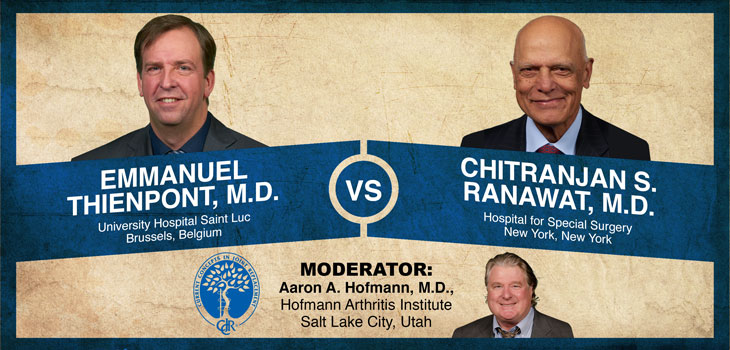
This week’s Orthopaedic Crossfire® debate was part of the 32nd Annual Current Concepts in Joint Replacement® (CCJR), Winter meeting, which took place in Orlando this past December. This week’s topic is “UKA: The Gold Standard for Medial Compartment Disease.” For the proposition is Emmanuel Thienpont, M.D., University Hospital Saint Luc, Brussels, Belgium. Opposing is Chitranjan S. Ranawat, M.D., Hospital for Special Surgery, New York, New York. Moderating is Aaron A. Hofmann, M.D., Hofmann Arthritis Institute, Salt Lake City, Utah.
Thienpont v. Ranawat—UKA: The Gold Standard for Medial Compartment Disease
7 min read Premium comments
Great Debates
Dr. Thienpont: I was indeed asked to defend the position for medial OA [osteoarthritis] for which the best treatment is unicompartmental knee arthroplasty (UKA) and not total knee arthroplasty (TKA). When you look at it, it’s always a discussion about if the glass half full or is it half empty. Should we consider UKA for this type of arthritis? When we look at a treatment, it should first be safe, of course. Then it should be effective for your patients—they want to have all their function restored and go back to sports. And then if you have to revise them, it has to be a minimal operation; it has to be as simple as possible.
We asked 300 surgeons what they would want for their own knee if they had medial OA and 87% want the uni. However, only 78% would propose it to their patients. So there is a 9% mis-match. And I hear Chit thinking, ‘But give me the data.’ And he’s right.
So if you look at survivorship, it’s clear that UKA is doing not so good when compared to TKA. There is a 3.5 times higher revision rate. But if you look at the reasons for revision (dislocation/instability, malalignment), these are technical aspects that are surgeon based. Also there is a high rate of unexplained pain, which is also an indication we can address ourselves. So there is a lot of surgeon bias in the reasons to revise a uni.
So why consider UKA then? UKA preserves natural kinematics. That is important. It allows a more physiologic gait pattern. There are less complications in UKA and especially stiffness. There is almost no arthrofibrosis after UKA in contrast to TKA where manipulation is required. All of these factors are important for your patient.
There is clearly lower morbidity and lower mortality. A paper published in the Lancet showed that the risk of dying is three times lower with UKA, and if you would do 100 patients, 1 of the 100 would die if you do a total knee. So that is important data that we have to discuss with patients.
We have published that there is much lower blood loss and no transfusions required with UKA, even if you have anemic female patients, which are the patients typically at risk.
There is also a lower infection rate, and it’s almost four times lower in uni patients.
We also noticed recently that younger patients do better with uni’s. In an initial paper that we published we had almost the same results for TKA as for UKA. And we asked ourselves the question, ‘Why this was happening?’ We saw that there were some mistakes in not matching age, sex, and especially the diversity of patients. The TKA population was much more female, with 7 cases out of 10, but in the UKA group it’s more 50-50. So when we matched all these factors we saw that females are doing as well with uni as with total knee. But young men were not doing that well with total knee. They are doing very well with the uni. Probably this is related to the absence of the ACL [anterior cruciate ligament] and they probably feel that AP [anterior/posterior] instability much more.
I would not propose doing a uni on patients with rheumatoid arthritis or any inflammatory diseases. Your success with UKA will also depend on your own technical capacity. The procedure is technically more demanding. It also depends on the function the patient wants. Will they be happy with the surgery that delivers them 100 degrees of flexion or really are they expecting much more? How do they feel about revision someday in their life? And finally, what is the pressure of your peers. If they see a uni, will they tell you to revise it?
Dr. Ranawat: Total knee is the gold standard and if you’ve never seen the gold, you only look at the silver.
Unicompartmental knee arthroplasty has been controversial for the last four decades and anything which is controversial for such a long period, raises the question that there has to be some problem. And the problem is… revision. Dr. Thienpont already admitted that the revision rate is higher in UKA. The medium to long-term results have been disappointing. We know that UKA has a very good marketing pitch. If you do it with minimally invasive techniques, it has very strong appeal to the patient.
The good thing about UKA is that it gives a patient a good range of motion. And quicker recovery.
So I’ll give you some data on TKA now. All-polyethylene total knees with 10-18 year follow-up in young, active patients…there were 46 knees I followed for a period of up to 18 years and Kaplan-Meier survivorship for mechanical failure was 97%, and failure for all causes was 92%. All patients had a satisfaction score of 5 or above. One of my more active patients…he was 47 when I performed an all-polyethylene, posterior stabilized reconstruction and 7 years after surgery he climbed Mount Kilimanjaro, up to 70-80% of the height.
Now I’ll give you 10-year data on rotating platform, posterior stabilized TKA. There were 138 consecutive patients…I did 117 patients. I had 106 knees at a minimum follow-up of 10 years. The average function and activity assessment scores improved post op in addition to range of motion. The majority of them were participating in some sporting activity. The Kaplan-Meier survivorship for these patients at 10 years was 97.8% when using revision for any reason as the endpoint.
A less than 10% failure rate is good in UKA, but if you look at Level 1 and 2 evidence in all the registry data, failure rates rise up to 30%. Patient selection, difficult learning curve, prosthetic design, component position, cement technique, or under correction and mechanically overloaded situations are the reasons for failure.
The Australian Registry, British Registry, Finnish Registry, and Swedish Registry show two things. The failure rate for UKA is high and has remained high. Failure rate of UKA is two to three times higher than TKA—British, 12% to 3%, Australian, 16% to 7%, Swedish, 15% to 6%, Finnish, 26% to 6%, respectively.
The positive factors are improved kinematics, preserved cruciates, quicker recovery and better quality and activity level. Negative factors are limited and precise indications, a steep learning curve, experience and volume matters, cement technique is difficult, unexplained pain is higher, higher failure rate due to wear and loss of fixation, and progression of disease in the untreated compartment.
Moderator Hofmann: Let me ask about some contraindications for unicompartmental replacement. Obviously, you do both, right, you do total knees, you do unicompartments, so what about that patient that has some anterior knee pain? Should we ignore it?
Dr. Thienpont: Depends on how you want to see it. We are running a study where we do a scan on patients to see if there really is damage or not. In many patients who have only anteromedial arthritis they still complain about what we call typical symptoms of the patella going up and down the stairs, coming out of the chair. So symptoms are not so easy. If you have isolated anteromedial wear, that’s a perfect indication to only replace the disease.
Moderator Hofmann: So what do you tell the patient…and this is always a tough question that I get and I do probably 10% of my patients with unis…’Is this operation going to last my lifetime?’ And that’s when I start backpedaling in the pre-op area. It’s like ‘Let’s talk about that total knee, because we always have the option to do either a total or a uni’, and so that question scares me off a lot of times.
Dr. Thienpont: It scares me also. It scares everyone. I think we have the data that shows that it’s probably not going to last a lifetime. It depends on how old they are, of course, even if a 90-year-old is asking me, I’m happy to be able to offer him a UKA. But I’m honest. I tell them what the failure rates are. The technical mistakes are probably a little bit less in my hands as Chit said it depends on the volume. The more you do, the better you get at it. I give them the statistics and even at 15 years, if you tell them it’s only 70% survival, some patients look at the glass as half full and they say, ‘Oh, 15 years, that’s far away.’
Moderator Hofmann: Dr. Ranawat, how do you respond to that?
Dr. Ranawat: I think that the failure rate is higher and with longer follow-up it gets higher. That’s the fact. The second, which is negative, is they have anteromedial pain.
Moderator Hofmann: I’m going to ask Dr. Thienpont, do you do anything to the patella? I learned from my German colleagues when I’m doing an unresurfaced patella, either for a uni or for a total, to denervate, that is you take the hot knife and you go around the periphery and cut the synovium around the patella. Do you do anything similar to the patella? Do a patelloplasty?
Dr. Thienpont: When we see medial patella wear, so only on the medial side, we are not very worried about it because when you do a uni you slightly correct the alignment. It stays varus, but it’s less varus than before, so that valgus aspect helps them. If they have lateral facet disease, it becomes either an indication for a total knee or it becomes an indication for a bi-compartmental, which we also do. That’s a combination of a uni with patello-femoral. You either resurface the patella or you denervate it. I think the best is to take the synovium away above and underneath and not just run around it.
Moderator Hofmann: Gentlemen, thank you very much.
Please visit www.CCJR.com to register for the 2016 CCJR Winter Meeting, – December 14 – 17 in Orlando.
React:
Discussion
This is a fascinating development. In my practice we've seen similar outcomes with the revised protocol. The key differentiator seems to be patient selection criteria. Has anyone else noticed the correlation with BMI thresholds?
Great point. I'd push back slightly on the conclusion, the sample size in the cited study is too small to draw population-level inferences. That said, the directional signal is compelling and worth a larger RCT.
We implemented a similar approach last year. Early results are promising but we're still gathering 12-month follow-up data. Happy to share our protocol if anyone is interested.
Join the conversation
Orthopedic professionals are discussing this. Sign in and upgrade to read every comment and add your voice.