
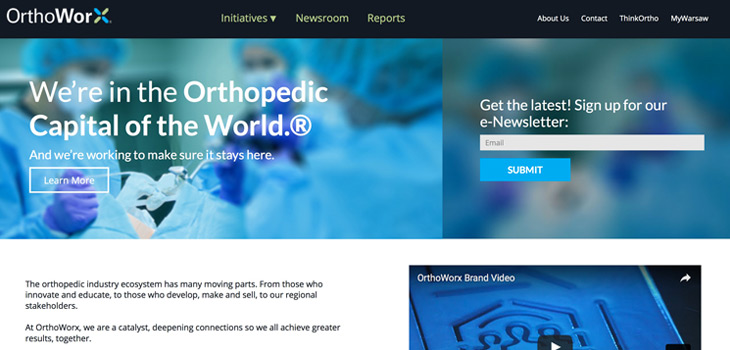
OrthoWorx has just rolled a new website, brochure, and video. In a July 1, 2016 email, the company stated, “… We look forward to continuing to work with our industry and academic partners, as well as other regional stakeholders, to continue to ensure Warsaw, Indiana remains the Orthopedic Capital of the World.”
OrthoWorx: Marketing Makeover
2 min read Premium comments
Secondary
Asked why this was the right time for this revamp, Sheryl Conley, OrthoWorx President and CEO, told OTW, “It’s been almost seven years since we were founded and based on our experience and where stakeholders have said we have had the most impact, we decided it was time to sharpen our message around the three strategic initiative areas: Talent Development, Talent Attraction and Innovation. In addition, we do our fund raising in three-year cycles, so our new materials will help us better communicate to those who we approach for support.
“Our region is the most concentrated cluster of orthopedic medical device activity in the world. We want everyone to understand that what happens here not only ripples through the economy, but it has an impact on patient lives globally and is important to our nation’s position as the medical technology leader. For us to maintain that distinction, we’ll need to develop talent and foster innovation more than ever before. We provide a vehicle for seeing that our industry cluster, communities and educators can come together to focus on what will be required to maintain our status as the Orthopedic Capital of the World.
“For the most part, our work does not involve surgeons, but they are affected every day by what goes on in our region. The companies here account for half the world’s joint reconstruction products and a great many of the instruments used to implant those products. Plus, the leading spinal implant manufacturer is here. Our medical device accelerator project, AcceLinx, is intended to select from the most promising start-up companies and fill the gap—the ‘valley of death’ between the time an idea is generated and the time when a large strategic player would typically invest. Some of those ideas may come directly from surgeons who need access to commercial operations expertise. Other start-ups may need surgeon input in the design and development of their technologies and may not have the connections larger companies would. Beyond that, we will help entrepreneurs engage with surgeons when a technology has reached the stage that it requires clinical evaluation.”
React:
Discussion
This is a fascinating development. In my practice we've seen similar outcomes with the revised protocol. The key differentiator seems to be patient selection criteria. Has anyone else noticed the correlation with BMI thresholds?
Great point. I'd push back slightly on the conclusion, the sample size in the cited study is too small to draw population-level inferences. That said, the directional signal is compelling and worth a larger RCT.
We implemented a similar approach last year. Early results are promising but we're still gathering 12-month follow-up data. Happy to share our protocol if anyone is interested.
Join the conversation
Orthopedic professionals are discussing this. Sign in and upgrade to read every comment and add your voice.