
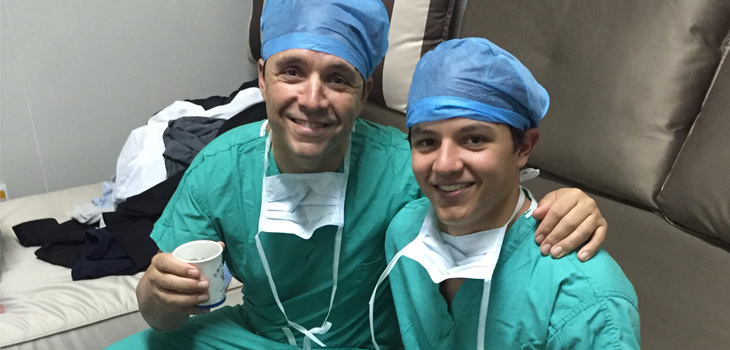
Thanks to the son of an orthopedic surgeon, people in a remote area of China have been able to benefit from total hip and knee replacements. United Orthopedic Corporation (UOC) has announced this donation, made to a hospital in Hefei China, 300 miles inland from Shanghai.
Orthopedic Surgeon, Son Aid Chinese Village
2 min read Premium comments
Secondary
According to the July 5, 2016 news release, “Freddy Achecar Jr., M.D., medical director for the WellStar Douglas Hospital Center for Joint Replacement in Douglasville, Georgia, donated his services to help patients with limited income needing knee or hip replacement surgery.”
“The donation was inspired by Dr. Achecar and his 17-year-old son Adam. As part of his Eagle Scout project, Adam wanted to incorporate his father’s work of restoring movement to patients who suffered from orthopedic conditions, and make treatment available to individuals who did not otherwise have access to such care.
Dr. Achecar liked his son’s idea and, as a result, reached out to his hospital’s supplier of orthopedic implants, UOC. UOC recommended that the doctor travel to the city of Hefei to help treat patients who had been historically underserved. UOC agreed to donate the necessary medical devices. The program was designed to provide patients with disabilities and the elderly, as well as low-income households, with joint replacement treatment they may otherwise not have had access to on their own.”
“We were thrilled to have had the opportunity to give back to communities in need and work with a leading orthopedic surgeon, ” said Calvin Lin, president of UOC USA, a subsidiary of UOC located in Irvine, California. “There are villages, towns and cities in China located in remote areas, limiting patients’ and healthcare professionals’ access to optimal treatment. Working with Dr. Achecar to improve the lives of these patients has been wonderful.”
Adam Achecar commented to OTW, “It was a very rewarding experience. I was grateful to have the opportunity to provide care for these people who could not afford or have access to the same quality of care. Immediately when we arrived to the hospital we were greeted by about 20 doctors and nurses and were followed by 2 or more cameramen at all times. They treated us like kings which is something I had never experienced before.”
Dr. Achecar told OTW, “This is my first medical mission trip. The conditions were nothing like I have ever experienced. My son completely arranged this trip as his Eagle Scout project, and I followed his lead. Although I was somewhat anxious about the trip, the reception that both the patients and the hospital staff gave us made it most rewarding. Knowing that these patients’ quality of life immediately improved because of our surgeries was very gratifying. I could have never predicted the amount of gratitude that was shown to us.
“Our first patient was a chicken farmer from a remote village. The day after surgery he was up without pain for the first time in many years. He sent his family home and they brought us back eggs in gratitude, which was all they could offer. This was one of the most kind and genuine gestures that I have ever received from a patient. On the long journey back home my son and I were already planning for our next trip.”
React:
Discussion
This is a fascinating development. In my practice we've seen similar outcomes with the revised protocol. The key differentiator seems to be patient selection criteria. Has anyone else noticed the correlation with BMI thresholds?
Great point. I'd push back slightly on the conclusion, the sample size in the cited study is too small to draw population-level inferences. That said, the directional signal is compelling and worth a larger RCT.
We implemented a similar approach last year. Early results are promising but we're still gathering 12-month follow-up data. Happy to share our protocol if anyone is interested.
Join the conversation
Orthopedic professionals are discussing this. Sign in and upgrade to read every comment and add your voice.