
Japanese researchers have created a novel hydrogel that, according to the July 14, 2016 news release, “…bonds spontaneously and strongly to defected bones, suggesting potential use in the treatments of joint injuries.”
New Hydrogel for Joint Injuries!
2 min read Premium comments
Secondary
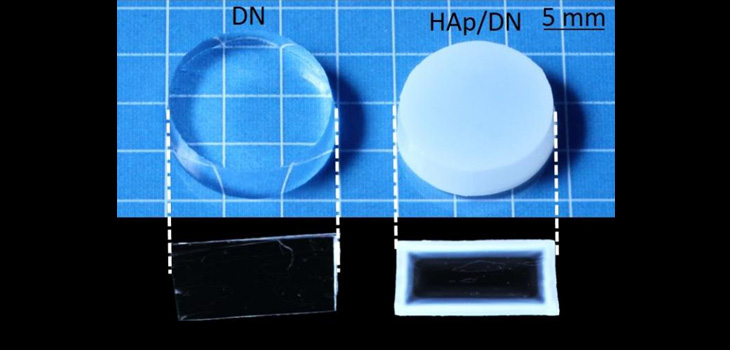
The team from Hokkaido University had in the past created a “tough, high-strength network gel, called double-network gel (DN gel) that exhibited excellent performance such as low wear and inductive function for cartilage regeneration. However, as the gel’s main component is water, it was difficult for it to bond with other surfaces—a major stumbling block in its practical application. The new gel, however, overcomes this problem. The team successfully added hydroxyapatite (HAp), the major inorganic component of bone, to the surface of DN gel by dipping it in calcium solution and phosphate solution. The HAp-coated DN gel (HAp/DN gel) was then transplanted into a defected bone in a rabbit. Four weeks later, the team observed that the gel had bonded to the bone very strongly, while the non-coated gel had not bonded at all. Electron-microscopic analysis revealed that the newly formed bone component in the defected area had penetrated into the gel surface, and fused to it seamlessly.”
“Tough, nontoxic hydrogel that adheres strongly to bone is a major advance in the treatment of joint and soft tissue injuries. The research results are also promising for the potential application of tough hydrogel materials as cartilages. “The bonding between HAp/DN gel and bone mimics physiological bonding seen with cartilage, ligament and tendon, causing less stress to the body. We expect that the gel could be used to firmly attach artificial ligament or tendon to bone”, said Jian Ping Gong, Ph.D., one of the lead authors of the paper published in Advanced Materials. The research was supported by Hokkaido University’s Global Institution for Collaborative Research and Education (GI-CoRE).”
Dr. Gong told OTW, “Our recent progresses in developing strong and tough double network hydrogels make these highly water-containing materials as promising substitutes of soft supporting tissues such as cartilages. However, bonding of hydrogels to bones is a great challenge for such potential application, as the hydrogels contain 90wt% of water.”
“It was a surprise for us that the spontaneous osteogenesis penetration into the hydrogel occurred to form a gel/bone hybrid layer as thick as 40 µm, thousands times larger than the network mesh size of the hydrogel.”
“We intend to develop biodegradable double network hydrogels that are tough and yet bondable to bones.”
React:
Discussion
This is a fascinating development. In my practice we've seen similar outcomes with the revised protocol. The key differentiator seems to be patient selection criteria. Has anyone else noticed the correlation with BMI thresholds?
Great point. I'd push back slightly on the conclusion, the sample size in the cited study is too small to draw population-level inferences. That said, the directional signal is compelling and worth a larger RCT.
We implemented a similar approach last year. Early results are promising but we're still gathering 12-month follow-up data. Happy to share our protocol if anyone is interested.
Join the conversation
Orthopedic professionals are discussing this. Sign in and upgrade to read every comment and add your voice.