
You might call them e-threads…nano size sensors located inside threads than can get a “read” on a variety of bodily data. Researchers led by Tufts University engineers have, according to the July 18, 2016 news release, “integrated nano-scale sensors, electronics and microfluidics into threads—ranging from simple cotton to sophisticated synthetics—that can be sutured through multiple layers of tissue to gather diagnostic data wirelessly in real time, according to a paper published in Microsystems & Nanoengineering. The research suggests that the thread-based diagnostic platform could be an effective substrate for a new generation of implantable diagnostic devices and smart wearable systems…The three-dimensional platform is able to conform to complex structures such as organs, wounds or orthopedic implants.”
Nano-Sensors in Threads to Gather Diagnostic Data!
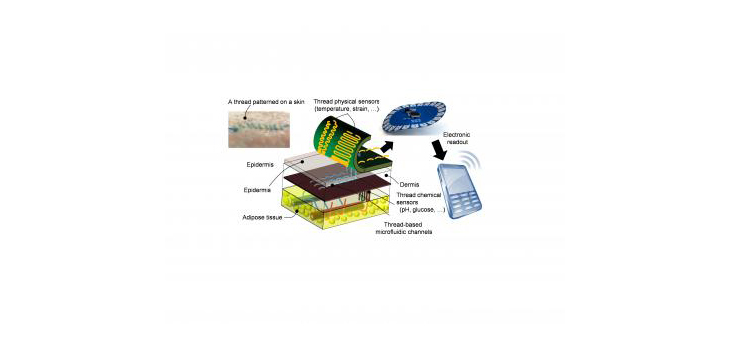
“The researchers used a variety of conductive threads that were dipped in physical and chemical sensing compounds and connected to wireless electronic circuitry to create a flexible platform that they sutured into tissue in rats as well as in vitro. The threads collected data on tissue health (e.g., pressure, stress, strain and temperature), pH and glucose levels that can be used to determine such things as how a wound is healing, whether infection is emerging, or whether the body’s chemistry is out of balance. The results were transmitted wirelessly to a cell phone and computer.”
“The ability to suture a thread-based diagnostic device intimately in a tissue or organ environment in three dimensions adds a unique feature that is not available with other flexible diagnostic platforms, ” said Sameer Sonkusale, Ph.D., corresponding author on the paper and director of the interdisciplinary Nano Lab in the Department of Electrical and Computer Engineering at Tufts University’s School of Engineering. “We think thread-based devices could potentially be used as smart sutures for surgical implants, smart bandages to monitor wound healing, or integrated with textile or fabric as personalized health monitors and point-of-care diagnostics.”
Dr. Sonkusale told OTW, “We were looking into making sensors that are truly flexible and can reach deep into tissues. Threads provide the ultimate in size, dimension and flexibility. We worked on wound healing applications where this can be revolutionary. Other potential applications include implantable devices, for example prosthetics, in which we would like to embed sensors. Another potential application is surgical thread to monitor infection. We were most surprised to find that one can achieve such sophisticated functionality from something as ubiquitous as threads.
“It’s important to note that more study is needed in a number of areas, including investigation of long-term biocompatibility. However, thread-based applications could enable surgeons to embed sensors to monitor physical parameters like stress and strain on an implant and chemical parameters like infection and inflammation within tissue. The data could help them determine the status of their implants or surgical operation.”
Discussion
This is a fascinating development. In my practice we've seen similar outcomes with the revised protocol. The key differentiator seems to be patient selection criteria. Has anyone else noticed the correlation with BMI thresholds?
Great point. I'd push back slightly on the conclusion, the sample size in the cited study is too small to draw population-level inferences. That said, the directional signal is compelling and worth a larger RCT.
We implemented a similar approach last year. Early results are promising but we're still gathering 12-month follow-up data. Happy to share our protocol if anyone is interested.
Join the conversation
Orthopedic professionals are discussing this. Sign in and upgrade to read every comment and add your voice.