
Shriners, Carter Center Lend a Hand in Haiti
Lending a Hand in Haiti; Getting VERY Active Patients Back in the Game; Texting to Reduce Infections
5 min read Premium comments
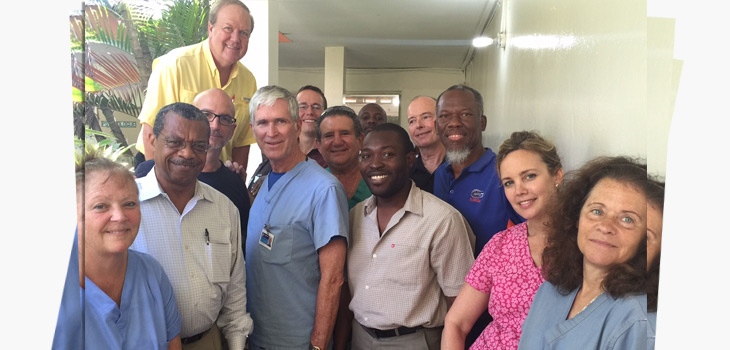
There are fewer children hurting in Haiti now thanks to the joint efforts of Shriners Hospitals for Children and The Carter Center. Representatives from both facilities recently returned from their first joint pediatric screening clinic in Haiti. The team was hosted by St. Boniface Hospital in Fond des Blancs, and evaluated children from the far reaches of the island nation for orthopedic conditions, burns, spinal cord injuries, and cleft lip and palate. The Carter Center worked with the Haitian Ministry of Health and Ministry of Disabilities to facilitate the screening.
Asked about the challenges in planning and executing the trip, Ken Guidera, M.D., chief medical officer of Shriners Hospitals for Children, told OTW, “The biggest challenge was to develop a care model to help the children locally, provide follow up, and to arrange care back in the U.S. at various Shriner Hospitals for those who need it. Working with The Carter Center was essential as they had been working in the country for many years.”
“It was a great eye opener as to the needs of the children in Southern Haiti. It was striking that the people had so little but were so appreciative and happy. The children were all well cared for and loved by their families. Their orthopedic needs are vast and ranged from clubfeet to scoliosis to hand deformities.”
Study: OCA Transplantation Gets VERY Active People Back in the Game
Athletes and other active patients take heart…if hit by a cartilage knee injury, says new research, an osteochondral allograft (OCA) transplantation could be their ticket back to activity. William Bugbee, M.D., lead author from the Scripps Clinic, studied osteochondral allograft transplantation in 149 knees, and found that 76% of those treated with the surgery returned to activity at an average of six years. The authors did find, however that these individuals often returned to their sport or other activities at a lower activity level.
Dr. Bugbee commented to OTW, “We have been implanting fresh osteochondral allograft transplants for over three decades and have anecdotally noticed how well they perform in athletic people, however these grafts have been traditionally used in severe or salvage cases when other cartilage repair hasn’t worked. Although allografts are becoming increasingly popular in cartilage repair, there is still reticence among sports surgeons to use them in higher demand athletes. We wanted to see in a scientific manner how well the allograft surgery performed in athletes.
“The majority (75%) of patients returned to sports participation, even if they had been injured for almost five years prior to allograft surgery and had undergone other operations. This rate of return is as good or better than return to sport for other cartilage procedures and even ACL [anterior cruciate ligament] reconstruction. Additionally the sporting activity did not lead to increase in failure rate of the allografts. In fact over 90% of patients in this study were very satisfied with their outcome and graft survivorship was 90% at ten years, among the highest we have seen in any group of patients we have studied.
“When one combines the fact that patients were injured an average of almost five years before we did the allograft surgery and the average follow-up was six years after surgery, I was amazed how many patients were able to get back to sports and remain active for so long. Of course the other interesting thing was to talk to patients I treated many years ago, when they were perhaps in high school and college or just starting careers, and to see where their lives had taken them. That’s what makes this work so fun and rewarding!”
Texting Reduces Surgical Site Infections
In what is the first study involving orthopedic surgery patients, researchers have shown that an automated communication system known as EpxDecolonization can help prevent surgical site infections (SSIs). This text and voice messaging system—developed by Epharmix, Inc.—improved communication about the steps patients should take a week prior to their operations (fill a prescription for an antibiotic ointment and body wash and use as directed). Every day prior to surgery patients receive a text or voice message in which they need to confirm that they are following bacterial decolonization protocols. Then, five days after an operation, the EpxWound system sends daily text or voice messages asking patients to report signs of infection, such as pain, redness, odor, or discharge at the site of surgery.
Michelle Keyin Lu and Christopher Chermside-Scabbo are independent researchers at Epharmix and authors on this paper. Neither holds a position in the company. They commented to OTW, “The idea of using an automated telecommunication system to improve surgical outcomes spawned out of a medical student start-up called Epharmix. Epharmix had developed automated messaging systems for chronic conditions including diabetes, COPD, heart failure, and others. Our group wanted to expand the use of the automated systems to surgical fields. Tonya An, a current orthopedic surgery resident at Cedars-Sinai, approached the orthopedic joint reconstruction team at Washington University in St. Louis and started the development of this project.
“This study tested the use of EpxDecolonization and EpxWound with 430 orthopedic joint replacement patients treated at Washington University Barnes-Jewish Hospital. It was impressive to find that 96% of patients responded to EpxDecolonization and 90% to EpxWound. Most patients believed the systems significantly improved communication with their surgeons (median score of 8 on a scale of 1 to 9) and rated their overall care as excellent (median score of 9). It’s an incredibly useful tool.
“We were surprised to find that the response rates with EpxDecol and EpxWound were the highest of all the Epharmix systems. Patients were engaged with the systems, and 96% and 90% of patients responded to the decolonization and wound systems, respectively. Patient satisfaction surveys showed that patients felt connected to their surgeons, and the texts/calls reinforced to the patients that they were doing the right things. Alternatively, since the incidence of SSIs is so low in the Washington University joint reconstruction service, we realized that we did not have adequate numbers to assess the sensitivity and specificity of our system. We intend to begin studying the system in other procedures that have higher complication rates such as hip fracture reduction.
“An automated texting/calling system has the potential to improve patient satisfaction and health-related outcomes as well as reduce costs due to complications. Patients feel connected to their healthcare providers with the system, and it can ease the burden of follow-up that falls on the staff. Most importantly, complications can be prevented or detected earlier to improve the care that surgeons can deliver to their patients.”
Author
React:
Discussion
This is a fascinating development. In my practice we've seen similar outcomes with the revised protocol. The key differentiator seems to be patient selection criteria. Has anyone else noticed the correlation with BMI thresholds?
Great point. I'd push back slightly on the conclusion, the sample size in the cited study is too small to draw population-level inferences. That said, the directional signal is compelling and worth a larger RCT.
We implemented a similar approach last year. Early results are promising but we're still gathering 12-month follow-up data. Happy to share our protocol if anyone is interested.
Join the conversation
Orthopedic professionals are discussing this. Sign in and upgrade to read every comment and add your voice.