
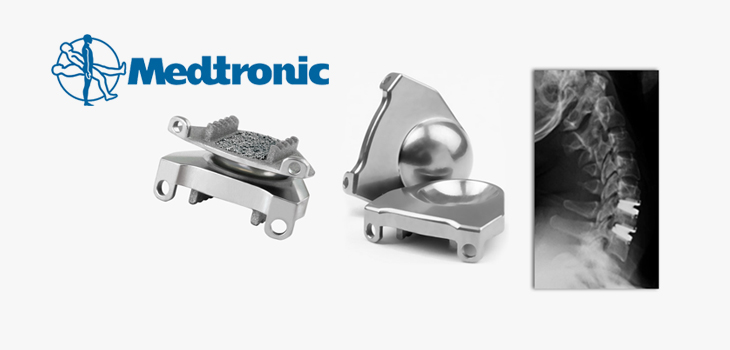
In 2014, the FDA granted premarket application (PMA) approval to Medtronic plc’s Prestige LP cervical disc for single level use. On July 7, 2016, the agency granted PMA approval for the same device, but for two-level use.
FDA Adds Two-Level Approval for Medtronic’s Cervical Disc
2 min read Premium comments
Secondary
The Prestige LP is the second cervical disc to receive approval for two-level cervical disc replacement (CDR) behind LDR’s Mobi-C which was approved in October 2013. Medtronic had expected approval by this coming October.
Medtronic and Zimmer Biomet
Wells Fargo analyst Larry Biegelsen believes the entry of market leader, Medtronic, into the two-level CDR market could “put some competitive pressure” on LDR’s Mobi-C. He noted Zimmer Biomet Holdings, Inc.’s recent announced to acquire LDR which is expected to close in the third quarter of 2016. “The two-level CDR market has significant growth potential but adoption has been measured primarily due to a lack of reimbursement coverage from private payers. Medtronic’s clout as the global spine market leader could drive increased reimbursement coverage and spur market expansion, but it is difficult to predict the timing of increased payer coverage.”
Seven Year Data
Earlier this year, Medtronic announced results of seven-year follow-up data demonstrating the clinical outcomes. The study is the longest patient follow-up data for U.S. 2-level cervical disc patients.
The company says a randomized controlled investigational device exemption (IDE) trial included a total of 397 study subjects (209 investigational and 188 control) and compared results up to seven years. Key findings of the statistical analysis at seven years show that the 2-level Prestige LP Disc patients:
- Exhibited greater rates in overall success (78.6%) compared to the patients treated with 2-level ACDF [anterior cervical discectomy and fusion] (62.7%) (by using Bayesian statistics, probability of superiority = 99.8%).
- Exhibited greater rates in neurological success (91.6%) compared to the patients treated with 2-level ACDF (82.1%) (probability of superiority= 99.0%).
- Exhibited greater success rates in patient-reported outcomes, including Neck Disability Index (87.0%), compared to the patients treated with 2-level ACDF (75.6%) (probability of superiority = 99.3%).
- Exhibited lower rates of second surgeries (4.2%) at the index levels compared to the patients treated with 2-level ACDF (14.7%).
- Adverse event profiles were similar between groups.
Motion Preservation Beats Fusion
As we reported in May, the Prestige is a motion preserving spine disc implant. Think of two dime-sized plates with shark fins balanced on a ball and socket which fits neatly between two vertebral discs in the human neck.
The last 18 months have been a rich period for clinical trial data regarding cervical disc arthroplasty. Including the Prestige study, there have been five prospective, randomized, multi-center, FDA IDE studies with an ACDF control arm released this past year.
There have also been three major meta-analysis studies encompassing up to 19 prospective randomized clinical trials and more than 6, 000 patients. Finally, there have also been three retrospective analysis studies conducted.
These studies were published in such peer review journals as SPINE, the Journal of Neurosurgery: Spine, The Spine Journal, The Journal of Bone and Joint Surgery, the European Spine Journal and Orthopedics and Traumatology Surgery and Research.
The conclusions, across the board, are the same. Overall, when compared to fusion, patients who receive disc arthroplasty tend to have less pain, more motion and return to work faster.
The science has proven the “protect” part of the FDA’s mission. The FDA listened and now has exercised its “promote” part of its mission.
Author
React:
Discussion
This is a fascinating development. In my practice we've seen similar outcomes with the revised protocol. The key differentiator seems to be patient selection criteria. Has anyone else noticed the correlation with BMI thresholds?
Great point. I'd push back slightly on the conclusion, the sample size in the cited study is too small to draw population-level inferences. That said, the directional signal is compelling and worth a larger RCT.
We implemented a similar approach last year. Early results are promising but we're still gathering 12-month follow-up data. Happy to share our protocol if anyone is interested.
Join the conversation
Orthopedic professionals are discussing this. Sign in and upgrade to read every comment and add your voice.