
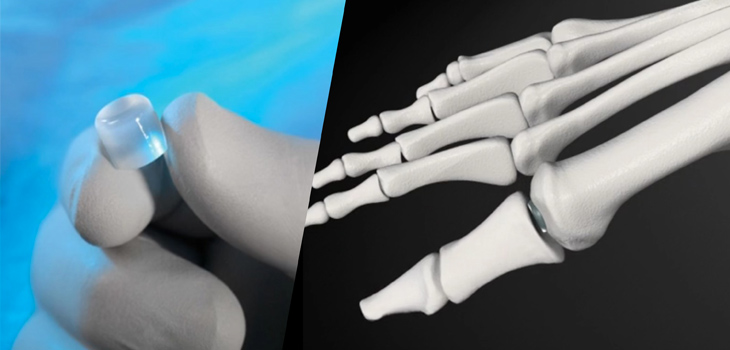
Cartiva, Inc. has announced that the first commercial U.S. patient has received the Cartiva Synthetic Cartilage Implant (SCI) following its approval by the U.S. Food and Drug Administration (FDA) on July 1. According to the July 12, 2016 news release, “The Cartiva SCI device is intended for use in the treatment of patients with painful arthritis at the base of the big toe, the most common arthritic condition in the foot. The outpatient procedure was performed by Judith F. Baumhauer, M.D. at University of Rochester Medical Center’s Sawgrass Surgery Center.”
Cartiva: First OP Procedure With Synthetic Cartilage Implant
2 min read Premium comments
Secondary
“Today, one in 40 Americans over the age of 50 experience arthritis of the toe, and with the aging population, that number is likely to grow. This condition can be particularly life-impacting—limiting a person’s ability to conduct functional activities of daily living, producing pain and discomfort and restricting shoe wear options, ” said Dr. Baumhauer. “The Cartiva implant was accomplished in a quick, simple surgical procedure and we look forward to offering this innovative option to more people in need.”
Dr. Baumhauer told OTW, “What I found very interesting and surprising during my first Cartiva Synthetic Cartilage Implant (SCI) procedure was how smoothly it all came together. As a surgeon, you always go in expecting the first procedure to take a little extra time or require some fussing or tweaks to be done. In this case, the Cartiva implant was easily inserted and on X-ray it visibly sat proud in the joint—exactly as it is designed to provide optimal comfort and minimize friction in the joint. In surgery, you don’t expect the first procedure to go off without a hitch and the smoothness of this procedure was surprising. Now, I am excited to find more patients who can benefit from the Cartiva implant.”
Regarding the recent FDA process, Cartiva President and CEO Timothy J. Patrick told OTW, “The most interesting part of the process was the set-up and conducting of the clinical trial. The Cartiva MOTION clinical study was the largest study ever undertaken for arthritis of the great toe joint. This gave us an opportunity to work with 20 of the top foot and ankle surgeons at 12 sites in Canada and the United Kingdom. These surgeons have over 500 published clinical papers collectively, so we were dealing with a very elite and accomplished surgeon group. The opportunity to work with surgeons of this caliber with such great clinical insight and knowledge was really interesting.
“The Cartiva implant is the first synthetic cartilage product approved by the FDA. It was subjected to the most rigorous clinical evaluation ever for a product that provides an alternative to permanent fusing of the joint. The procedure is simple and quick and requires a very minimal tool set. Patients are not restricted to a boot or cast after surgery, are able to bear weight as tolerated. The data shows that patients can expect significant pain reduction, improved function and improved range of motion.”
Author
React:
Discussion
This is a fascinating development. In my practice we've seen similar outcomes with the revised protocol. The key differentiator seems to be patient selection criteria. Has anyone else noticed the correlation with BMI thresholds?
Great point. I'd push back slightly on the conclusion, the sample size in the cited study is too small to draw population-level inferences. That said, the directional signal is compelling and worth a larger RCT.
We implemented a similar approach last year. Early results are promising but we're still gathering 12-month follow-up data. Happy to share our protocol if anyone is interested.
Join the conversation
Orthopedic professionals are discussing this. Sign in and upgrade to read every comment and add your voice.