
Researchers at the University of Bristol School of Cellular and Molecular Medicine have developed a stem cell bio-ink that can produce 3D printed cartilage and bone implants. The new stem cell ink contains two different polymers. One is a natural polymer extracted from seaweed. The second is a synthetic polymer that causes the ink to solidify when temperatures are raised. The seaweed-based material provides the structural support that is deemed necessary to sustain cell nutrients.
3D Bio-Ink Prints Cartilage and Bone
1 min read Premium comments
Secondary
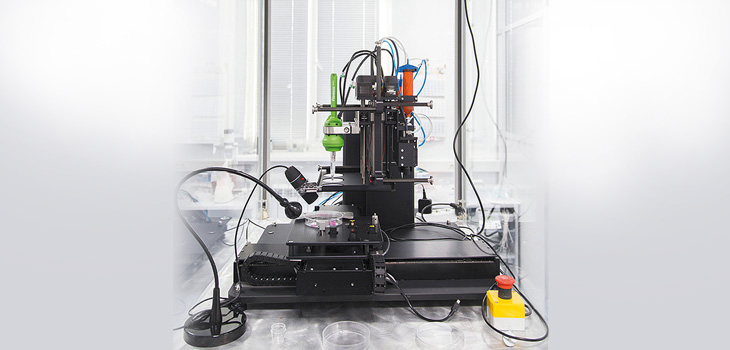
The project is directed by Adam Perriman, M.D. who explained that the custom formulation can be extruded by a 3D printer to form complex living 3D architectures, which will start to transform from a liquid into a gel at 37°C. Perriman said, “Designing the new bio-ink was extremely challenging. You need a material that is printable, strong enough to maintain its shape when immersed in nutrients, and that is not harmful to the cells. We managed to do this, but there was a lot of trial and error before we cracked the final formulation.”
Perriman noted that the synthetic material is only temporarily present. “What was really astonishing for us was when the cell nutrients were introduced, the synthetic polymer was completely expelled from the 3D structure, leaving only the stem cells and the natural seaweed polymer. This, in turn, created microscopic pores in the structure, which provided more effective nutrient access for the stem cells, ” he said.
The stem cells present in the bio-ink are purposefully adapted to be used for 3D bioprinted bone and cartilage implants. They achieved this by differentiating the stem cells into osteoblasts and chondrocytes which are cells that secrete bone and cartilage matrixes. Over a period of several weeks, according to Perriman, these materials grow into full-sized cartilage or bone structures that can be implanted.
The research group’s findings have been published in the journal of Advanced Healthcare Materials in a paper entitled “3D Bioprinting Using a Templated Porous Bioink.”
Author
React:
Discussion
This is a fascinating development. In my practice we've seen similar outcomes with the revised protocol. The key differentiator seems to be patient selection criteria. Has anyone else noticed the correlation with BMI thresholds?
Great point. I'd push back slightly on the conclusion, the sample size in the cited study is too small to draw population-level inferences. That said, the directional signal is compelling and worth a larger RCT.
We implemented a similar approach last year. Early results are promising but we're still gathering 12-month follow-up data. Happy to share our protocol if anyone is interested.
Join the conversation
Orthopedic professionals are discussing this. Sign in and upgrade to read every comment and add your voice.