
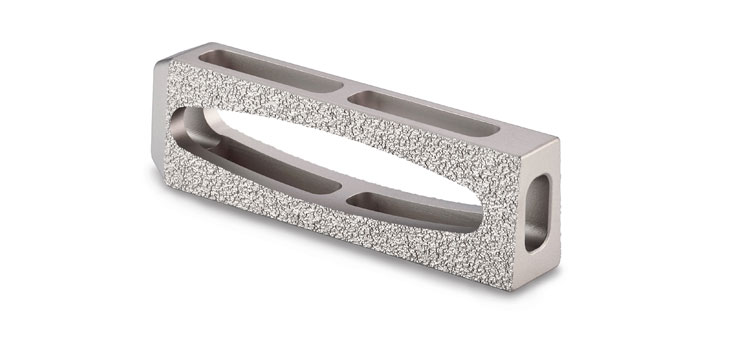
“Confidence” is key at Titan Spine! The company has announced that it is, according to the June 13, 2016 news release, “enhancing its spinal device warranty to provide a free replacement if any of the Company’s Endoskeleton interbody fusion devices delaminate or generate particulate debris during implantation. The amended warranty is a direct reflection of the Company’s confidence in its proprietary subtractive manufacturing process that was further validated in a recent study published in The Spine Journal demonstrating that the Company’s Endoskeleton titanium interbody fusion devices generated no particulate debris or delamination during simulated impaction in to the disc space, as opposed to those made with an additive coating.”
Titan Spine Enhances Device Warranty
2 min read Premium comments
Secondary
Peter Ullrich, M.D., Chief Executive Officer of Titan Spine, LLC, commented, “Since we first announced our warranty in 2014, we have received overwhelming positive feedback from hospitals, surgeons, and patients. We are excited to expand our warranty to now include full coverage of the device if it is ever removed due to delamination or detached titanium particles. Our most-recent study has generated spirited debate in our industry whether titanium material stays bound during impaction or not when manufactured using a subtractive versus various additive coating techniques. Our science and our experience in the marketplace that includes over 45, 000 implantations has confirmed that the titanium on our devices stays bound during implantation and in-situ, which is critical to ensure patient safety.”
Titan President Kevin Gemas added, “Hospitals and health systems look very favorably on companies who are willing to risk share by standing behind their technologies. We are interested to see which of our fellow interbody device manufacturers are willing to follow our lead and shoulder the liability of backing their devices regardless of patient co-morbidities or the biologic used.”
Dr. Ullrich told OTW, “The decision to amend our warranty can be summed up in one word: confidence. Confidence that our devices and our surface technology can withstand the rigors of implantation followed by the ability to prompt the body to heal quickly. We have published data to support both claims. It wasn’t a difficult decision to make. We are confident in placing the onus on Titan rather than shifting the legal burden to the surgeon, which other companies have done by language they include in their Instructions for Use.”
React:
Discussion
This is a fascinating development. In my practice we've seen similar outcomes with the revised protocol. The key differentiator seems to be patient selection criteria. Has anyone else noticed the correlation with BMI thresholds?
Great point. I'd push back slightly on the conclusion, the sample size in the cited study is too small to draw population-level inferences. That said, the directional signal is compelling and worth a larger RCT.
We implemented a similar approach last year. Early results are promising but we're still gathering 12-month follow-up data. Happy to share our protocol if anyone is interested.
Join the conversation
Orthopedic professionals are discussing this. Sign in and upgrade to read every comment and add your voice.