
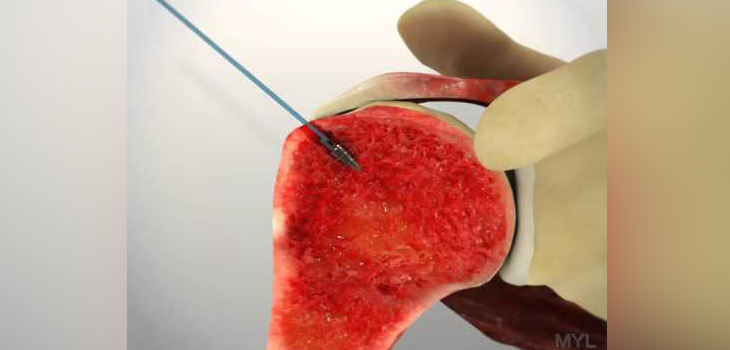
New work from University of Missouri researchers has found that suture anchors, a less-invasive repair technique than the standard transosseus repair, responded better to postoperative strength-testing, supporting more movement in the knee earlier in the recovery process.
Suture Anchors Trump Transosseus Repair
2 min read Premium comments
Secondary

" data-large-file="https://i0.wp.com/ryortho.com/wp-content/uploads/2016/06/StudySuture_SethLShermanMD_WEB.jpg?fit=220%2C275&ssl=1" src="https://i0.wp.com/ryortho.com/wp-content/uploads/2016/06/StudySuture_SethLShermanMD_WEB.jpg?resize=220%2C275&ssl=1" alt="Seth L. Sherman, M.D." width="220" height="275">Seth L. Sherman, M.D.
“The suture anchor technique requires a smaller incision and disrupts less of the patient’s normal anatomy around the knee, ” said Seth L. Sherman, M.D., assistant professor of orthopedic surgery at the University of Missouri (MU) School of Medicine, in the May 16, 2016 news release. “By using a minimally invasive approach, we create a better healing environment for the knee, which supports more movement in the knee earlier after surgery.”
As indicated in the news release, “Sherman conducted tendon-repair surgeries using both techniques on human cadaveric tendon specimens. After the surgeries, Sherman, along with Ferris Pfeiffer, Ph.D., assistant professor in the MU College of Engineering and School of Medicine, simulated rehabilitation to test the strength of the repaired tendons. Sherman and Pfeiffer found that the tendons repaired with the less-invasive suture anchor technique had significantly less gapping after the stress tests. Gapping is a sign of a weak tendon repair in which a gap between the tendon and the bone occurs, decreasing the tendon’s ability to heal.”
“The researchers also found no difference in the amount of pressure the tendon could withstand during either technique. Sherman said this means not only were the suture anchors more resistant to gapping, but they also had the same ultimate strength as transosseous tunnel repairs.”
“While the suture anchor technique has advantages, such as shorter operating time and less damage to soft tissue, one disadvantage is the cost effectiveness of the procedure, Sherman said. Sherman cites a 2012 study published in Orthopedics that found the cost of using suture anchors ranged from $435 to $560 per patient, approximately $190 to $320 more than the transosseous technique. However, earlier rehabilitation in the suture anchor group may offset this initial difference.”
On June 13 Dr. Sherman told OTW, “As sports medicine surgeons, we are always looking for innovative ways to provide our patients with minimally invasive surgical options that are equivalent or superior in strength and healing capacity to previous open approaches. Biomechanical studies and clinical success using suture anchors for shoulder pathology (i.e., rotator cuff, labrum, pectoralis tendon) have opened the door for us to prove that applying the same principles to major tendon ruptures about the knee can be safe and effective.
“The surgical technique of suture anchor quadriceps tendon repair is simple, efficient, and reproducible. It is minimally invasive with less surgical dissection, decreasing compromise to injured tissue and improving the healing environment. Suture anchor quadriceps tendon repair resists cyclic loading better than transosseous suture fixation. This allows for safe early range of motion to decrease the risk of post-surgical stiffness without increased risk of loss of time zero tendon-to-bone fixation.”
React:
Discussion
This is a fascinating development. In my practice we've seen similar outcomes with the revised protocol. The key differentiator seems to be patient selection criteria. Has anyone else noticed the correlation with BMI thresholds?
Great point. I'd push back slightly on the conclusion, the sample size in the cited study is too small to draw population-level inferences. That said, the directional signal is compelling and worth a larger RCT.
We implemented a similar approach last year. Early results are promising but we're still gathering 12-month follow-up data. Happy to share our protocol if anyone is interested.
Join the conversation
Orthopedic professionals are discussing this. Sign in and upgrade to read every comment and add your voice.