
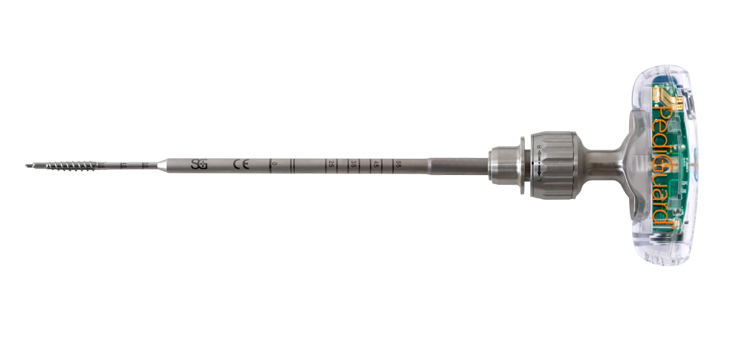
SpineGuard is announcing the receipt of 510(k) clearance from the U.S. FDA for its new PediGuard Threaded DSG (Dynamic Surgical Guidance) device.
SpineGuard: 510(k) for PediGuard Threaded DSG
2 min read Premium comments
Secondary
“We are very excited by the clearance of our PediGuard Threaded device, which brings a new generation of DSG-enabled probes to the U.S. market, offering spine surgeons the added clinical benefit of reducing surgical steps in fusion surgery. This clearance allows our network of agents to initiate the commercial phase of this unique value proposition in a $7-billion market that is under price pressure and in tremendous need for differentiation, ” said Stephane Bette, Co-founder, CTO and U.S. General Manager of SpineGuard, in the June 16, 2016 news release.
“The PediGuard Threaded device with DSG technology embedded inside may be used in open or minimally invasive approaches for pedicle screw insertion. It is available in various designs to accommodate surgeons’ preferences and patients’ anatomy. A single-use DSG pin embedded with the bipolar sensor is inserted into the cannula of the threaded shaft and connected to the electronic processor inside the single-use DSG handle. The distal tip of the threaded shaft includes an awl-like tip to facilitate redirection of the device until the tip is past the pedicle isthmus, ” according to the news release.
Pierre Jerome, co-founder and CEO of SpineGuard, told OTW, “Less than two years ago, the PediGuard Threaded Drill project was tossed around as one of the ways to extend the PediGuard portfolio. There were a lot of unanswered questions at that time. However, in less than six months R&D started working on it as a project, in less than six months after R&D first started this project we had six surgeons from across the U.S. come together in a lab to evaluate/validate the design on a cadaveric specimen. Before the lab there were quite a few skeptics in this small group of surgeons. However, after the lab, all of them were total believers in the new device(s). That lab was the most defining moment of this project.
“More recently, since we were anticipating FDA clearance, we’ve shown these devices to our sales management team. The feedback has been overwhelmingly positive. Our sales team is very eager to take these to our customers.
“In a nutshell, the speed at which this project has come to fruition and the feedback we’ve received from surgeon evaluators and our sales team are all very exciting and point to a very bright future for SpineGuard.
“PediGuard Threaded is a ‘three-in-one’ probe designed to optimize the insertion, the positioning and the anchorage of pedicle screws into the vertebra with minimal use of X-rays. It complements SpineGuard’s range of ‘smart’ drilling instruments equipped with DSG (Dynamic Surgical Guidance) technology, whose clinical value keeps on being reinforced by new studies. Over 80 surgeries have already been successfully performed with this novel device by seven surgical teams in Europe and Asia.”
React:
Discussion
This is a fascinating development. In my practice we've seen similar outcomes with the revised protocol. The key differentiator seems to be patient selection criteria. Has anyone else noticed the correlation with BMI thresholds?
Great point. I'd push back slightly on the conclusion, the sample size in the cited study is too small to draw population-level inferences. That said, the directional signal is compelling and worth a larger RCT.
We implemented a similar approach last year. Early results are promising but we're still gathering 12-month follow-up data. Happy to share our protocol if anyone is interested.
Join the conversation
Orthopedic professionals are discussing this. Sign in and upgrade to read every comment and add your voice.