
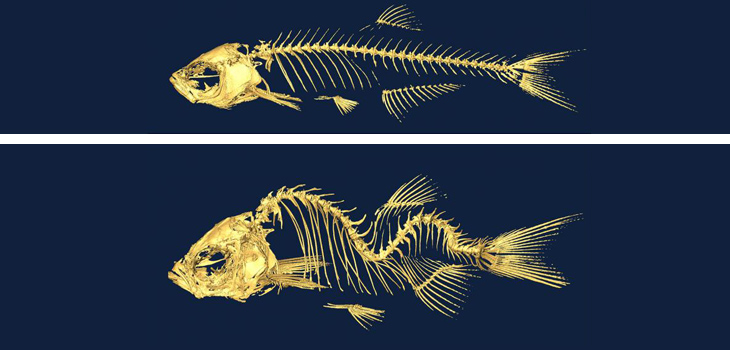
New work from Princeton University and the University of Toronto has utilized a zebrafish model, and suggests that, according to the June 10, 2016 news release, “irregular fluid flow through the spinal column brought on by gene mutations is linked to a type of scoliosis that can affect humans during adolescence. Found in humans and zebrafish, these mutated genes damage the cilia—tiny hair-like projections that line the spinal canal and help move the fluid—and lead to a curvature of the spine.”
Scoliosis Related to Spinal Flow Disruptions?
2 min read Premium comments
Secondary
“The researchers found that when they repaired the mutated cilia genes, they restored cerebrospinal fluid flow and could prevent spinal curves from developing. If translatable to humans, the study could lead to a non-surgical approach for treating the condition known as idiopathic scoliosis, which has no known cause and affects roughly three out of every 100 adolescents.”
“This is the first hint of a biological mechanism for idiopathic scoliosis, ” said Rebecca Burdine, Ph.D., associate professor of molecular biology at Princeton, and a senior author of the study. “We hope this research will open up new areas of inquiry as to how the disruptions to normal cerebrospinal fluid flow can lead to spinal curvature.”
The study was undertaken in collaboration with a team led by senior author Brian Ciruna, Ph.D., an associate professor of molecular genetics at the University of Toronto and a senior scientist at the Hospital for Sick Children in Toronto.
“We demonstrated that if we could restore gene function in the motile ciliated tissues, we could restore cerebrospinal fluid flow, and we could actually prevent scoliosis in these mutants, ” Ciruna said.
The next step will be to understand the mechanisms by which disrupted cerebrospinal fluid flow causes the spine to curve, Burdine said.
“Now that we can study idiopathic scoliosis in zebrafish, ” she said, “we can begin to identify molecular pathways that are involved in spine curvature, and hopefully, find therapeutic targets to address this condition.”
Dr. Burdine told OTW, “Our study suggests that reduced cerebrospinal fluid (CSF) flow might induce spinal curves, or prevent the spine from correcting existing curves, which then progress into scoliosis. This is also influenced by the underlying genetics and environmental factors, but we note scoliosis can be caused by other disorders that affect CSF flow such as is seen in those with Chiari malformations. Thus, the measurement of CSF flow might be a useful diagnostic and prognostic tool when assessing scoliosis onset, progression, and its links to other conditions.”
React:
Discussion
This is a fascinating development. In my practice we've seen similar outcomes with the revised protocol. The key differentiator seems to be patient selection criteria. Has anyone else noticed the correlation with BMI thresholds?
Great point. I'd push back slightly on the conclusion, the sample size in the cited study is too small to draw population-level inferences. That said, the directional signal is compelling and worth a larger RCT.
We implemented a similar approach last year. Early results are promising but we're still gathering 12-month follow-up data. Happy to share our protocol if anyone is interested.
Join the conversation
Orthopedic professionals are discussing this. Sign in and upgrade to read every comment and add your voice.