
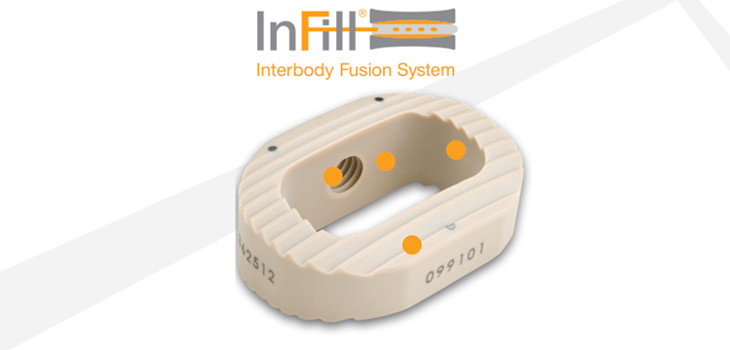
Pinnacle Spine Group, LLC has announced the launch of its InFill Anterior Lumbar Interbody Fusion (ALIF) Interbody Device, which, according to the June 1, 2016 news release, is “is designed to maximize wall thickness and graft chamber volume, ensuring optimal contact with the vertebral endplates by both the interbody device and bone graft material. Pinnacle Spine Group has pioneered the novel concept of placing bone graft material in situ into an implanted device in order to allow optimal bone graft material volume and maximized contact with vertebral endplates—a critical element for a successful spine fusion outcome.”
Pinnacle Spine Launches InFill ALIF
2 min read Premium comments
Secondary
“Anterior lumbar spinal fusion is a common spine fusion technique, but often must be combined with an additional posterior approach to provide immediate stabilization. Science shows that in many unilateral posterior lumbar interbody fusion procedures, less than 50% of the disc area is actually grafted, ” said Pinnacle Spine President Zach Sowell. “Pinnacle is committed to innovation that offers surgeons and patients options which address significant challenges in spinal fusion and enable more effective spinal fusion surgeries. We are excited to add the InFill ALIF device to our growing line of patented fusion systems.”
As indicated in the news release, “Features of the ALIF device include:
- Optimization for use in the L5/S1 disc space
- A gently bulleted nose for ease of insertion
- The option for in situ delivery of bone graft material to ensure a more complete fill
- A large graft chamber which facilitates formation of a robust fusion column
- An aggressive tooth design to prevent displacement of the device
- A large surface area which provides maximum contact with the apophyseal ring, helping to restore and maintain disc space and height
- Tantalum rod markers which provide excellent radiographic visualization of interbody device orientation and placement.”
Asked about comments they are getting from surgeons, Sowell told OTW, “We’ve received positive feedback on the InFill ALIF Interbody Device from surgeons who appreciate its unique design for lumbar spine fusion. They see the potential of the design of the InFill ALIF implant, which maximizes wall thickness and graft chamber volume, that helps ensure optimal contact with the vertebral bodies by both the device and bone graft material. Also, surgeons find the insertion instrumentation intuitive and easy to use.”
“The InFill ALIF Interbody Device is important because it completes our InFill Interbody Fusion System, a comprehensive patented range of implants and instrumentation that may help make spine fusion surgery less expensive and more effective. With the introduction of the InFill ALIF device, we hope that a year from now Pinnacle Spine’s complete system will be the implant and graft delivery platform of choice among spine surgeons and patients.”
React:
Discussion
This is a fascinating development. In my practice we've seen similar outcomes with the revised protocol. The key differentiator seems to be patient selection criteria. Has anyone else noticed the correlation with BMI thresholds?
Great point. I'd push back slightly on the conclusion, the sample size in the cited study is too small to draw population-level inferences. That said, the directional signal is compelling and worth a larger RCT.
We implemented a similar approach last year. Early results are promising but we're still gathering 12-month follow-up data. Happy to share our protocol if anyone is interested.
Join the conversation
Orthopedic professionals are discussing this. Sign in and upgrade to read every comment and add your voice.