
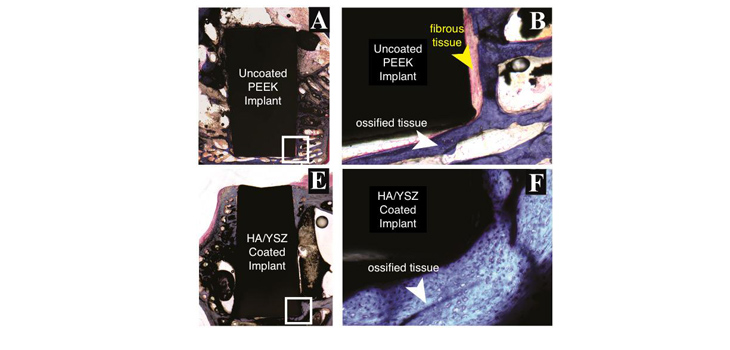
Scientists from North Carolina State University, the University of Cambridge and the University of Texas at San Antonio have developed a technique for coating polymer implants with a bioactive film that, according to the June 15, 2016 news release, “significantly increases bonding between the implant and surrounding bone in an animal model. The advance could significantly improve the success rate of such implants, which are often used in spinal surgeries.”
New Bioactive Film for Coating Implants
2 min read Premium comments
Secondary
“We can now use our technique to coat the entire surface of an implant, and testing HA-coated [hydroxyapatite] implants in an animal model has given us very promising results, ” says Afsaneh Rabiei, Ph.D., a professor of mechanical and aerospace engineering at NC State and corresponding author of a paper on the work.
First, a PEEK implant is coated with a thin film of yttria-stabilized zirconia (YSZ); then a coating of HA is applied. As indicated in the news release, “The researchers then heat the HA layer using microwaves. The YSZ layer acts as a heat shield, preventing the PEEK from melting. Meanwhile, the heat gives the HA a crystalline structure that makes it more stable in the body, meaning that the calcium phosphate will dissolve more slowly—promoting bonding with surrounding bone.”
“Whether looking at bone growth or toughness, HA-coated samples outperformed uncoated PEEK implants, ” Dr. Rabiei said. “This treatment will probably increase the cost of an implant marginally, but should help minimize the need for follow-up surgeries—which means HA-treated implants will more than pay for themselves over time.”
Dr. Rabiei told OTW, “The number of spinal implant procedures is increasing in the U.S. Market and the majority of those are spinal fusion surgeries. There are hundreds of thousands of spinal fusion procedures performed in the U.S. each year. Complications arising from such surgery procedures can vary from infection to pseudoarthrosis (failure of the device to fuse after the procedure). These complications can cause the failure of implant and the need for revision surgery. As the result, there is a critical need to develop novel technologies to reduce the incidence of revision surgeries for orthopedic implants, particularly spine implants and improve their fusion.
“Our novel technique of using room temperature deposition of a hydroxyapatite (HA) coating on polymeric devices like PEEK (polyetheretherketone) followed by microwave heat-treatment without damaging the substrate has proved to represent a solution to the lack of fusion of such devices and it can dramatically enhance the feasibility of using low-modulus polymers in applications that were previously considered impractical because of concerns over their poor tissue integration. Our novel technology has the advantage of maintaining excellent bond strength between the substrate and the coating while improving tissue compatibility, enhancing bone apposition and performance of the implant in the body. The final result would be the faster recovery of the patient, improved tissue integration of the implant with less potential for the implant failure and its need for revision surgery.”
React:
Discussion
This is a fascinating development. In my practice we've seen similar outcomes with the revised protocol. The key differentiator seems to be patient selection criteria. Has anyone else noticed the correlation with BMI thresholds?
Great point. I'd push back slightly on the conclusion, the sample size in the cited study is too small to draw population-level inferences. That said, the directional signal is compelling and worth a larger RCT.
We implemented a similar approach last year. Early results are promising but we're still gathering 12-month follow-up data. Happy to share our protocol if anyone is interested.
Join the conversation
Orthopedic professionals are discussing this. Sign in and upgrade to read every comment and add your voice.