
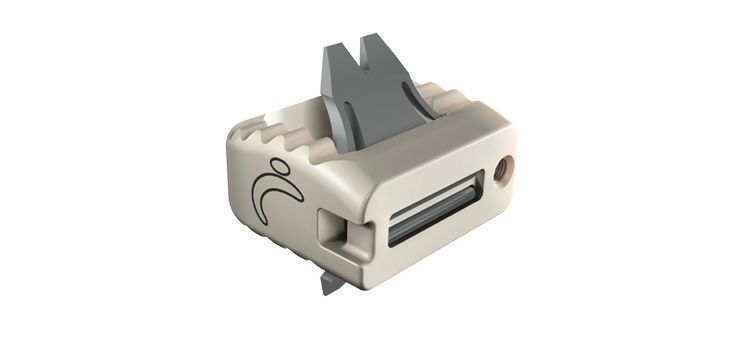
LDR Holding Corporation has announced that the initial implantations of the ROI-C Titanium-Coated Cervical Cage have taken place. The first surgeries were performed by Mark Giovanini, M.D., a board-certified neurosurgeon specializing in minimally invasive spine surgery in Pensacola, Florida, and Neil Romero, M.D., a board-certified orthopedic surgeon specializing in minimally invasive spine surgery and arthroplasty in Lafayette, Louisiana.
LDR: First Implantations of ROI-C Titanium Cervical Cage
2 min read Premium comments
Secondary
Dr. Giovanini shared in the June 02, 2016 news release, “The addition of ROI-C Titanium-Coated implants is a big step forward. ROI-C’s VerteBRIDGE plating system makes for procedural simplicity, and I could feel the additional friction provided by the titanium coating.”
Dr. Romero added, “ROI-C already requires fewer steps than most other systems on the market, and the addition of titanium coating is a great enhancement. Having the radiolucency of PEEK combined with the roughness of the plasma sprayed titanium all in one implant is beneficial.”
According to the news release, “The ROI-C Titanium-Coated Implant System offers a porous plasma-sprayed titanium coating on both the superior and inferior surfaces of the radiolucent PEEK-OPTIMA cage. Like all ROI-C Cervical Cage implants, the titanium-coated version is available in four footprints, five heights, and in both an anatomic dome and flat lordotic implant design. With ROI-C’s inline implantation method, an angled approach is not necessary to deploy the VerteBRIDGE plating. This allows for a small incision and a streamlined approach, which may be especially beneficial at the superior and inferior levels of the cervical spine. The ROI-C Implant System & ROI-C Titanium-Coated Implant System are indicated for use in skeletally mature patients with degenerative disc disease (DDD) of the cervical spine with accompanying radicular symptoms at one disc level from C2-T1.”
LDR President and CEO Christophe Lavigne commented, “We are pleased to offer surgeons a new option for our already best-in-class ROI-C Cervical Cage system, which accounts for a majority of the over 100, 000 implantations of VerteBRIDGE plating worldwide. The patented in-line plating technology makes optimal use of a minimally invasive surgical technique and, consistent with LDR’s Minimal Implant Volume (MIVo) surgery philosophy, gains stability while leaving less hardware in the patient than would a conventional discectomy and fusion with an anterior cervical plate and screws. As a global cervical spine solution provider, LDR continues to introduce innovative products to accommodate the needs of a quickly changing market, and we are excited to add ROI-C Titanium-Coated Cages to our growing list of products. In support of our strategic focus on cervical motion preservation with the Mobi-C Cervical Disc, the ROI-C Cervical Cage represents an attractive option for patients not indicated for cervical disc who may benefit from cervical fusion instead.”
Asked how this product makes his life as a surgeon better, Dr. Giovanini told OTW, “The availability of ROI-C Cervical Cages with Titanium Coating provides me with additional options for the treatment of my patients. When performing an ACDF [anterior cervical discectomy and fusion] procedure, I appreciate the opportunity to use a cage with the additional roughness provided by the plasma sprayed Titanium.”
Christophe Lavigne told OTW, “The ROI-C Cervical Cage is an attractive option for patients not indicated for our Mobi-C Cervical Disc who may benefit from cervical fusion instead. Having said that, to drive the success of our full range of cervical solutions, our goal has been and continues to be to train as many surgeons as possible so they can make the most informed decision regarding the needs of their patients.”
Author
React:
Discussion
This is a fascinating development. In my practice we've seen similar outcomes with the revised protocol. The key differentiator seems to be patient selection criteria. Has anyone else noticed the correlation with BMI thresholds?
Great point. I'd push back slightly on the conclusion, the sample size in the cited study is too small to draw population-level inferences. That said, the directional signal is compelling and worth a larger RCT.
We implemented a similar approach last year. Early results are promising but we're still gathering 12-month follow-up data. Happy to share our protocol if anyone is interested.
Join the conversation
Orthopedic professionals are discussing this. Sign in and upgrade to read every comment and add your voice.