
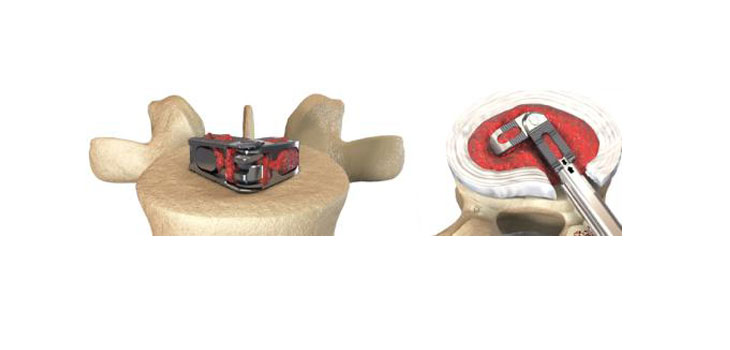
Spine specialists Expanding Orthopedics Inc. are announcing that Frank M. Phillips, M.D. of Midwest Orthopedics at Rush in Chicago has started to use the FLXfit articulated and lordotic expandable cage for his TLIF fusion surgeries.
Frank Phillips, M.D. Adopts Expanding Orthopedics’ FLXfit
1 min read Premium comments
Secondary
Dr. Phillips, co-founder and Board member of the Society of Minimal Invasive Spine Surgery (SMISS), says in the June 13, 2016 news release, “I appreciate the elegant design of the FLXfit expandable cage”. He notes “the FLXfit enables the surgeon to dial-in lordosis inside the disc space and provide a true anatomical fit with a wide footprint, which could lead to better patients’ outcomes.”
Dr. Phillips added, “I am a firm believer in MIS surgeries as they are associated with reduced lengths of stay, blood loss, surgical time, complications, morbidity and expenses”. In his eyes, “the FLXfit is an ideal expandable interbody device for MIS surgery. The FLXfit allows for easy and smooth insertion and positioning in the disc space while providing a large surface area for support with its unique articulated shape and expands lordotically, restoring the patient’s anatomy and sagittal balance”. Dr. Philips concludes, “The initial results with the FLXfit applied in a MIS fashion are very encouraging. This is an ideal device to facilitate lordosis creation via a TLIF approach.”
Expanding Orthopedics CEO Ofer Bokobza stated, “we are excited to collaborate with a top surgeon as Dr. Phillips and his team. Dr. Phillips, one of the pioneers of MIS in the world, is joining a group of key opinion leaders who decided to adopt the FLXfit 3D expandable cage as a preferred alternative for TLIF fusion device to treat their patients.”
Bokobza told OTW, “It is important for orthopedic surgeons to know that they are finally able to enhance sagittal alignment through a single small portal access, placing a big footprint implant directly on the apophyseal ring and dialing lordosis in situ in a continuous manner until it optimally matches the patient’s anatomy.”
React:
Discussion
This is a fascinating development. In my practice we've seen similar outcomes with the revised protocol. The key differentiator seems to be patient selection criteria. Has anyone else noticed the correlation with BMI thresholds?
Great point. I'd push back slightly on the conclusion, the sample size in the cited study is too small to draw population-level inferences. That said, the directional signal is compelling and worth a larger RCT.
We implemented a similar approach last year. Early results are promising but we're still gathering 12-month follow-up data. Happy to share our protocol if anyone is interested.
Join the conversation
Orthopedic professionals are discussing this. Sign in and upgrade to read every comment and add your voice.