
Force-Induced Treadmill Ramps Up Rehabilitation
Force-Induced Treadmill New Stem Cell Source, and Listening to Bones…and More!
5 min read Premium comments
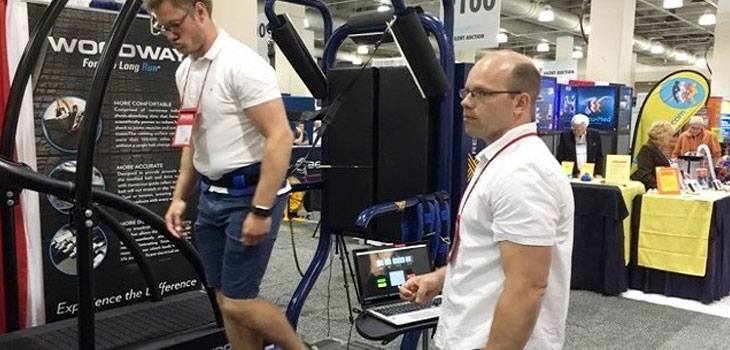
The Alliance for Innovative Medical Technology (AIMTech) has just showcased its first product at the 63rd annual meeting of the American College of Sports Medicine (ACSM). A novel, force-induced treadmill meant for rehabilitation, the ResistX is meant for patients who are recovering from surgery, injury, or stroke. Thanks to a custom algorithm, the device employs resistive forces to increase the amount of work required by an individual to move under his or her own effort, and at a comfortable pace.
Robert Hergenrother, Ph.D., is director of AIMTech and a biomedical engineering professor at the University of Alabama at Birmingham (UAB). He told OTW, “Christopher Hurt, Ph.D. and David Brown, P.T., Ph.D. developed the idea of providing exercise training to people with gait and balance disabilities who can’t run fast or run up a hill, etc. We made a simple prototype out of elastic bands in order to prove the concept. We then approached the Woodway company (makers of treadmills) and they said, ‘Make it more automated and we will exhibit it at the ACSM.’”
“Part of the challenge was showing how the machine was matching up with standard exercise protocols (running at a certain speed for a certain amount of time at a certain incline). We had to figure out how to do that at a constant speed and only changing the horizontal force. You have to get the adjustment of the horizontal force right in order to make sure that it feels natural when walking.”
Dr. Hurt told OTW, “This equipment will allow for rehabilitation of individuals with gait or balance disabilities. With this device, people who walk at a slower pace can train by modifying work loads through the application of a horizontal resistive force. In this way individuals can perform task specific strength training (i.e., while walking) and experience a cardiorespiratory stimulus.”
AIMTech is a collaboration of Birmingham-based non-profit Southern Research and the University of Alabama at Birmingham.
New Twist on Stem Cell Treatments
Scott A. Rodeo, M.D., Co-Chief Emeritus of the Sports Medicine and Shoulder Service at Hospital for Special Surgery, is helping to advance a new way of looking at cell-based approaches. Dr. Rodeo tells OTW, “There are basic limitations in stem cell research that we need to solve. At present, we can use bone marrow or fat and isolate stem-like cells, but the number of true stem cells is actually very small. Ideally we can do cell sorting, and isolate and culture the stem cells. The problem is that the FDA does not allow you to take anything from a patient, carry out specific ‘manipulations, ’ and reimplant it, so our hands have been tied.”
“We know intrinsically that many types of tissue have a small number of stem cells in the walls of the blood vessels. We are working with scientists at Weill Cornell Medical Center on a population of tissue-specific endothelial cells that can produce factors that stimulate the intrinsic stem cells in various tissues. For example, blood vessels in the liver contain a population of cells that produce factors that regulate the liver stem cells, etc. The tissue specificity means that cells from the blood vessels in the liver wouldn’t affect the lung stem cells. Our team is using a tendon model, and applying techniques for isolating and culturing cells from the walls of the blood vessels in the tendon.”
“The FDA wants to ensure that if we use a population of these cells that we can guarantee that the chain of custody and appropriate sterility have been maintained. We are also looking at the possibility of using the same approach in a post-traumatic arthritis model. Approximately 50% of patients who experience an ACL [anterior cruciate ligament] injury develop early arthritis by 15 years after injury, with or without surgery. We want to determine if we can interrupt the process early by using these cells. We need to be able to intervene early. In these situations, the die is likely already cast at the time of the initial injury in that the inflammatory environment, mechanical changes, etc., are already contributing to the risk of progressive arthritis. At the present time we have no great interventions.”
“Although we are still in a mouse model, the preliminary data is promising. The Weill Cornell group has years of data in various tissues, including liver, lung, etc., so this is all based on a strong platform and basic science underpinning. Now that we know these cells can be harvested and expanded safely and in a sterile fashion, the goal is to move towards clinical trials.
Listen to Your Bones…Really!
Researchers at the Georgia Institute of Technology have created a device that lets you listen in on your bones as they work. The device, loaded with microphones and vibration sensors, could one day help orthopedic surgeons measure sounds inside the joint.
Omer Inan, Ph.D. is an assistant professor in the department of Bioengineering at the Georgia Institute of Technology. Dr. Inan, a former discus thrower who was a three-time NCAA All-American at Stanford University and the school record holder, has a history of knee pain.
Dr. Inan told OTW, “I threw discus competitively as co-captain of the Track and Field team at Stanford. Practices typically consisted of heavy weightlifting, such as squats with 500+ lbs. and power cleans with 350+ lbs. In addition to these lifting exercises, the act of throwing discus itself imposes significant stresses on the knee joints due to the explosive twisting and extension movements required to perform the ‘spin.’ These experiences were, as one can imagine, taxing on my knees and led to my appreciation for the need for better tools for quantifying knee health in everyday settings.”
And when the Defense Advanced Research Projects Agency (DARPA) issued a call for research proposals on wearable technologies for assisting rehabilitation, Dr. Inan jumped into the fray and earned sponsorship of DARPA’s Biological Technologies Office. According to the May 23, 2016 news release, the researchers are now graphing out the recorded audio and matching it to the joint’s range of motion to see where exactly in the leg’s extending and bending the knee creates creaks and pops. The result has peaks and squiggles that resemble an electrocardiogram or other physiological signal.
Dr. Inan told OTW, “The first time I heard the sounds, I was struck by how loud they were, and how consistent they were for particular movements. Our team then decided that analyzing the sounds in the context of particular activities would be a solid first step toward assessing joint health based on features of the sounds. This aspect—the analysis of the sounds in the context of activity—is what we are currently using to assess joint health rehabilitation following acute knee injury.”
Dr. Inan’s device could lead to inexpensive, wearable monitors, which could benefit athletes, elderly patients, and soldiers with multiple battlefield knee injuries.
According to the news release, the device includes microphones and piezoelectric film, a hypersensitive vibration sensor that is very sensitive to interference. There is also a smart phone technology involved—micro-electromechanical systems microphones, or MEMS. This is what makes the microphones so inexpensive, coming in at 50 cents to a dollar.
Dr. Inan told OTW, “Though the work is still in an early stage with respect to the analysis of joint sounds in injured subjects, we believe that this technique can have great value for quantifying rehabilitation following reconstructive surgery.”
Author
React:
Discussion
This is a fascinating development. In my practice we've seen similar outcomes with the revised protocol. The key differentiator seems to be patient selection criteria. Has anyone else noticed the correlation with BMI thresholds?
Great point. I'd push back slightly on the conclusion, the sample size in the cited study is too small to draw population-level inferences. That said, the directional signal is compelling and worth a larger RCT.
We implemented a similar approach last year. Early results are promising but we're still gathering 12-month follow-up data. Happy to share our protocol if anyone is interested.
Join the conversation
Orthopedic professionals are discussing this. Sign in and upgrade to read every comment and add your voice.