
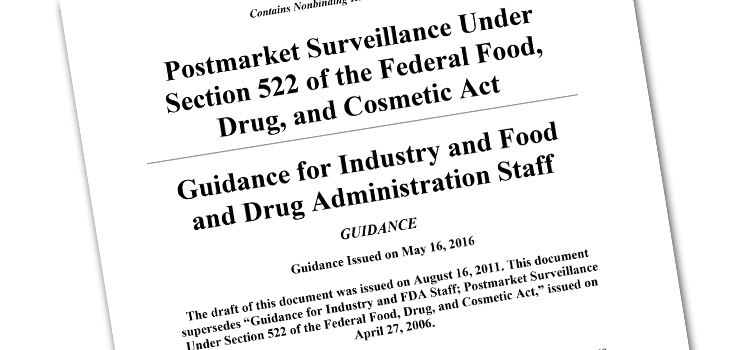
Five years after putting out a draft guidance, the FDA issued a final Postmarket Surveillance Section 522 guidance document on May 16, 2016.
FDA Issue Final “522” Postmarket Surveillance Guidance
2 min read Premium comments
Secondary
Congress first granted the FDA authority to require manufacturers to conduct postmarket surveillance under section 522 of the Safe Medical Devices Act of 1990. For example, we’ve seen the agency exercise this authority by requiring makers of metal-on-metal hips to conduct postmarket surveillance after adverse events are reported. But that authority has been open to interpretation and industry has asked for clearer guidance.
The FDA says the guidance is meant to help device manufacturers subject to section 522 postmarket surveillance orders by providing:
- An overview of the section of the law that allows FDA to require such studies;
- Information on how to fulfill 522 order obligations; and
- Recommendations on the format, content and review of postmarket surveillance plan submissions.
In general, the guidance says the law authorizes FDA to order “prospective postmarket surveillance for duration of up to 36 months unless the manufacturer and FDA agree to extend that timeframe or, if there is no agreement, after the completion of a dispute resolution.”
The agency offers examples of situations that may raise postmarket questions, including:
- Instances where FDA wants to better understand the nature, severity or frequency of suspected problems reported in adverse event reports or in the published literature.
- To obtain more information on device performance in real-world clinical practice.
- To address long term or infrequent safety and effectiveness issues for implantable and other devices for which the premarket testing provided more limited information. “For example, premarket evaluation of a device may have been based on surrogate markers. Once the device is actually marketed, postmarket surveillance may be appropriate to assess the effectiveness of the device in detecting or treating the disease or condition, rather than the surrogate. Data collected through postmarket surveillance may include rates of malfunction or failure of a device intended for long-term use or incidents of latent sequelae resulting from device use.”
- To better define the association between problems and devices when unexpected or unexplained serious adverse events occur after a device is marketed, if there is a change in the nature of serious adverse events (e.g., severity), or if there is an increase in the frequency of serious adverse events.
The guidance document covers the following topics:
- Legal Background
- Pre-522 Postmarket Surveillance Process
- Postmarket Surveillance Plans
- Interim Postmarket Surveillance Reports
- Final Postmarket Surveillance Reports
- Content and Format of Interim and Final Postmarket Reports
- Postmarket Surveillance Status Determination
To read the entire guidance document, click here.
Author
React:
Discussion
This is a fascinating development. In my practice we've seen similar outcomes with the revised protocol. The key differentiator seems to be patient selection criteria. Has anyone else noticed the correlation with BMI thresholds?
Great point. I'd push back slightly on the conclusion, the sample size in the cited study is too small to draw population-level inferences. That said, the directional signal is compelling and worth a larger RCT.
We implemented a similar approach last year. Early results are promising but we're still gathering 12-month follow-up data. Happy to share our protocol if anyone is interested.
Join the conversation
Orthopedic professionals are discussing this. Sign in and upgrade to read every comment and add your voice.