
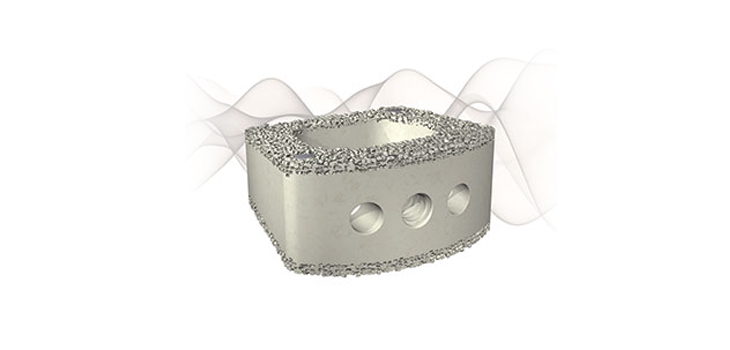
Surgeons at Rush University, Chicago, Illinois, are among the first to implant the Porous PEEK COHERE Cervical Fusion Device made by Vertera Spine. Frank Phillips, M.D., a professor at Rush University, was one of the first surgeons to use COHERE in a cervical fusion surgery. “I think the porosity of the COHERE PEEK interbody device will allow for more rapid osseointegration seen with textured surface devices, while at the same time allowing for excellent radiographic visualization of the fusion. We have learned that Scoria’s porosity promotes implant osseointegration with the surface characteristics being more important than the implant material.”
COHERE Device for Cervical Surgery Gains Adherents
2 min read Premium comments
Secondary
Other early adapters are James L. Chappuis, M.D., chief surgeon at SpineCenterAtlanta in Atlanta, Georgia, who has implanted over a dozen COHERE implants and Richard Fessler, M.D., also a professor at Rush University. Fessler said, “Using the COHERE implant was a seamless transition from the allograft cage I previously used. I have been impressed with its easy insertion as well as the durability of the porous PEEK during implantation.”
Chappuis said, “I have been looking forward to adopting COHERE into my clinical practice. Vertera Spine’s porous PEEK Scoria addresses the challenges of current PEEK cages that are bio inert as well as metal cages that make it difficult to assess fusion on X-ray and CT.”
J. Kenneth Burkus M.D, another COHERE clinical user from the Hughston Clinic in Columbus, Georgia, shares similar sentiments. He said, “The ability of COHERE to osseointegrate and not produce any imaging artifacts is unprecedented for spine fusion devices. What convinced me to use this device is the fact that the porous PEEK implant is made from one material and does not have to rely on any coatings to provide osteoconductivity.”
Vertera Spine officials note that while porous metal or metal-coated implants have been used before in spinal fusion applications, COHERE is the first device for clinical use that is manufactured entirely from PEEK. The COHERE device contains porosity making it suitable for use in anterior cervical fusion procedures to treat single or multi-level spinal pathologies.
COHERE introduces a porous osteoconductive environment to bone without compromising the mechanical integrity of the implant, according to the company’s news release which notes that multiple studies report the advantages of adding porosity over two-dimensional roughness to implants to improve their ability to osseointegrate.
Vertera officials point out that PEEK Scoria’s three-dimensional porous structure has been specifically tailored to optimize bone formation on the cellular level as well as form a strong interface with bone. Since the implant is made entirely out of PEEK polymer, COHERE provides the additional advantage of allowing accurate visualization of the fusion site when compared to metallic implants.
Vertera Spine is a privately held medical device company that has received funding from the National Science Foundation, Georgia Research Alliance, and Duke Angel Network to translate its technology portfolio into commercial products.
Author
React:
Discussion
This is a fascinating development. In my practice we've seen similar outcomes with the revised protocol. The key differentiator seems to be patient selection criteria. Has anyone else noticed the correlation with BMI thresholds?
Great point. I'd push back slightly on the conclusion, the sample size in the cited study is too small to draw population-level inferences. That said, the directional signal is compelling and worth a larger RCT.
We implemented a similar approach last year. Early results are promising but we're still gathering 12-month follow-up data. Happy to share our protocol if anyone is interested.
Join the conversation
Orthopedic professionals are discussing this. Sign in and upgrade to read every comment and add your voice.