
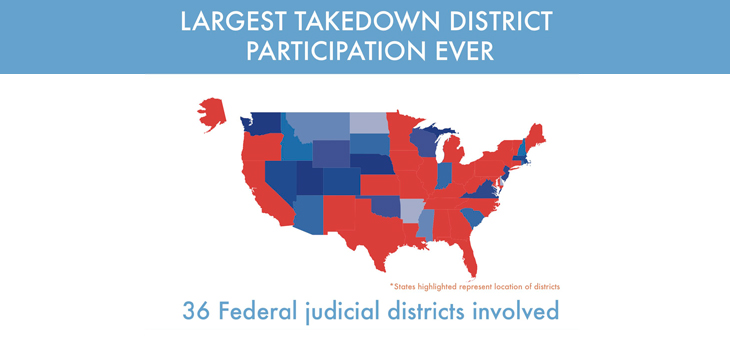
On June 22, 2016, the U.S. Department of Justice (DOJ) completed the “largest takedown ever” against defendants allegedly defrauding Medicare and other federal insurance programs.
Biggest Medicare Fraud Bust in History
3 min read Premium comments
Secondary
The DOJ filed criminal and civil charges against 301 individuals, including 61 doctors, nurses and other licensed medical professionals, for their alleged participation in health care fraud schemes involving approximately $900 million in false billings.
Were any orthopedic surgeons, providers or businesses named as defendants? Not a one that we could find, although it’s possible some of the physicians charged may be orthopedic surgeons.
For instance,
- In the Southern District of California, eight individuals were charged. In one case, five individuals, including a doctor and a pharmacist, were charged in a scheme to pay bribes and kickbacks to doctors in exchange for prescribing expensive durable medical equipment (DME) and compound pain creams that were not medically necessary. The indictment alleges that approximately $27 million in false and fraudulent claims were submitted to insurers.
- In the Middle District of Tennessee, a doctor was charged for his role in an illegal kickback scheme under which he allegedly referred patients to a certain DME supplier in exchange for cash kickbacks.
Home Health and Drugs
According to the DOJ, about 50% of the cases involved some form of home health fraud, and about 25% involve pharmacy fraud.
The defendants were charged with “various health care fraud-related crimes, including conspiracy to commit health care fraud, violations of the anti-kickback statutes, money laundering and aggravated identity theft. The charges are based on a variety of alleged fraud schemes involving various medical treatments and services, including home health care, psychotherapy, physical and occupational therapy, durable medical equipment and prescription drugs.”
More than 60 of the defendants arrested were charged with fraud related to the Medicare Part D prescription drug benefit program, which is the fastest-growing component of the Medicare program overall.
According to court documents, the defendants allegedly “participated in schemes to submit claims to Medicare and Medicaid for treatments that were medically unnecessary and often never provided. In many cases, patient recruiters, Medicare beneficiaries and other co-conspirators were allegedly paid cash kickbacks in return for supplying beneficiary information to providers, so that the providers could then submit fraudulent bills to Medicare for services that were medically unnecessary or never performed.”
Here’s a list of some of the “takedowns:”
- Southern District of Florida, a total of 100 defendants were charged with offenses relating to their participation in various fraud schemes involving approximately $220 million in false billings for home health care, mental health services and pharmacy fraud.
- In the Southern District of Texas, 24 individuals were charged in cases involving over $146 million in alleged fraud. One of these defendants is a physician with the highest number of referrals for home health services in the Southern District of Texas.
- In the Northern District of Texas, 11 people were charged in cases involving over $47 million in alleged fraud. In one scheme, a physician allowed unlicensed individuals to perform physician services and then billed Medicare as if he performed them.
- In the Central District of California, 22 defendants were charged for their roles in schemes to defraud Medicare of approximately $162 million. In one case, a doctor was charged with causing almost $12 million in losses to Medicare through his own fraudulent billing, including performing medically unnecessary vein ablation procedures on Medicare beneficiaries.
- In the Eastern District of Michigan, 19 defendants face charges for their alleged roles in fraud, kickback, money laundering and drug distribution schemes involving approximately $114 million in false claims for services that were medically unnecessary or never rendered.
- In the Middle District of Florida, 15 individuals were charged with participating in a variety of schemes including compounding pharmacy fraud and intravenous prescription drug fraud involving $17 million in fraudulent billing.
- In the Northern District of Illinois, six individuals were charged in cases related to three different schemes involving bribery and false and fraudulent claims for home health services and disability benefits.
- In the Eastern District of New York, ten individuals were charged in six different cases, including five individuals who were charged for their roles in a scheme involving over $86 million in physical and occupational therapy claims to Medicare and Medicaid.
- In the Northern District of Georgia, nine defendants were charged for their roles in two health care fraud schemes involving $7 million in fraudulent billings. Eight defendants were charged in a scheme where bribes and kickbacks were allegedly paid to a state of Georgia official in exchange for falsifying applications and licensing requirements and recommending the approval of unqualified mental health providers.
As bundled payments become mandatory and post-surgical costs are seen as the likeliest target for cost control, this “take down” adds fuel to increased scrutiny of post-surgical care.
Author
React:
Discussion
This is a fascinating development. In my practice we've seen similar outcomes with the revised protocol. The key differentiator seems to be patient selection criteria. Has anyone else noticed the correlation with BMI thresholds?
Great point. I'd push back slightly on the conclusion, the sample size in the cited study is too small to draw population-level inferences. That said, the directional signal is compelling and worth a larger RCT.
We implemented a similar approach last year. Early results are promising but we're still gathering 12-month follow-up data. Happy to share our protocol if anyone is interested.
Join the conversation
Orthopedic professionals are discussing this. Sign in and upgrade to read every comment and add your voice.