
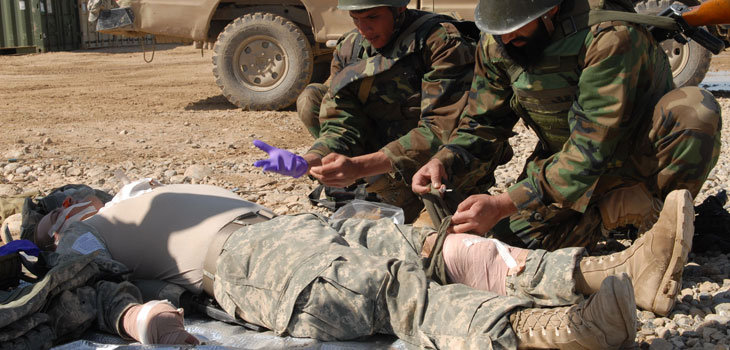
A new literature review in the June 2016 issue of the Journal of the American Academy of Orthopaedic Surgeons (JAAOS), has found that “deployed military service members who were engaged in sustained combat operations over a 15-month period were three times more likely to suffer non-combat musculoskeletal injuries than combat musculoskeletal injuries.”
15 Months of Combat: Leads to Non-Combat Musculoskeletal Injuries
2 min read Premium comments
Secondary
Retired Army Colonel Philip J. Belmont, M.D., lead author the study, commented to OTW, “The combined wars in Afghanistan and Iraq have a combined casualty estimate that exceeds 59, 000. The nature of this combat has led to increases in severe orthopaedic injuries, including traumatic amputations and injuries to the spine. Nearly 75% of all injuries sustained in combat are now caused by explosive mechanisms and fractures comprise 40% of all musculoskeletal injuries. Musculoskeletal injuries are expensive and have some of the highest rates of long-term disability. Non-combat musculoskeletal injuries are endemic within deployed military service members and occur at a greater than three-fold rate compared to combat musculoskeletal injuries. Service members with musculoskeletal injuries, behavioral health conditions and low socioeconomic status are at an increased risk of inferior outcomes.”
“Factors concerning musculoskeletal injuries in U.S. Army service members are important to the Veterans Health Administration (VHA) and the civilian practitioners responsible for the long-term care of soldiers permanently disabled as a result of combat since few service members continue to receive care from military treatment facilities following separation from service. Many are treated at VHA hospitals, which are staffed entirely by civilian orthopaedic surgeons and others elect to receive care from orthopaedic practices in the communities in which they live.”
Asked about the most debilitating for the soldiers, Dr. Belmont told OTW, “It is very difficult to make a blanket statement on which injuries are the most debilitating for the soldiers. Our studies though have revealed the devastating nature of combat musculoskeletal injuries.”
“Of all combat casulaties, 77% sustained at least one orthopaedic injury, and the incidence rate was determined to be 3.06 per 1, 000 personnel deployed per year (Belmont et al. J Ortho Trauma 2013 Reference – 5). Fractures represented 40% of all musculoskeletal wounds, and amputations comprised 6% of all such injuries. The incidence rate for fractures was 3.41 per 1, 000 deployed service members per year, whereas the rate of amputations was 0.52 per 1, 000 service members (Belmont et al. J Ortho Trauma 2013 Reference – 5).”
“A further analysis suggested that although extremity injuries comprised only half of all war trauma, such injuries were responsible for a greater proportion of resource consumption during care than were other injuries (Masini et al. J Ortho Trauma 2009 Reference – 15). Combat-related extremity injuries required the longest average inpatient stay (10.7 days), were responsible for 64% of total inpatient resource utilization and ultimately disabled 64% of those injured (Belmont et al. J Ortho Trauma 2013 Reference – 5). In addition, extremity injuries resulted in the largest burden of repeat hospitalizations after combat wounding.”
React:
Discussion
This is a fascinating development. In my practice we've seen similar outcomes with the revised protocol. The key differentiator seems to be patient selection criteria. Has anyone else noticed the correlation with BMI thresholds?
Great point. I'd push back slightly on the conclusion, the sample size in the cited study is too small to draw population-level inferences. That said, the directional signal is compelling and worth a larger RCT.
We implemented a similar approach last year. Early results are promising but we're still gathering 12-month follow-up data. Happy to share our protocol if anyone is interested.
Join the conversation
Orthopedic professionals are discussing this. Sign in and upgrade to read every comment and add your voice.