
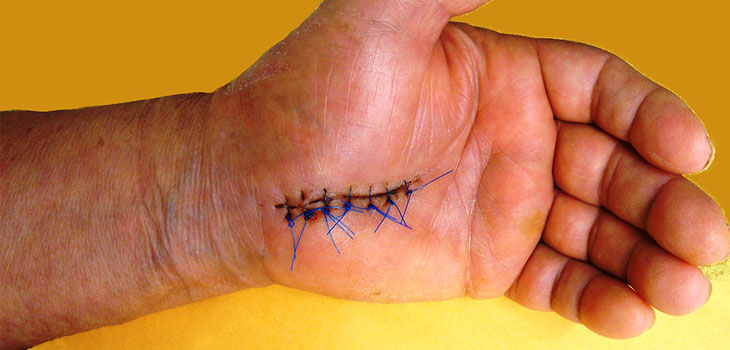
Anticipating carpal tunnel surgery? If so, consider what Gerson Florez, M.D., an orthopedic surgeon at Monongahela Valley Hospital, Pennsylvania, is advocating. He calls it “wide awake surgery” and he recommends the use of a local anesthetic for almost all surgery on the hand.
“Wide Awake Surgery” Recommended for Hands
1 min read Premium comments
Secondary
As Observer-Reporter staff writer Natalie Reid Miller explained, to be eligible for traditional surgery a patient must first undergo expensive tests, get an X-ray, abstain from eating or drinking for hours before the surgery and must be driven by a friend or family member to and from the hospital. When patients awaken in the recovery room they are often nauseous and may have a headache. Some patients, especially older ones, experience confusion.
Florez explained that a patient undergoing wide-awake hand surgery can eat breakfast, drive himself to the hospital where his arm will be injected with a local anesthetic. The surgery site will be draped to hide it from the view of possibly squeamish patients and Florez will mark the areas of the incision on the patient’s hand. “With wide-awake surgery, ” he said, “confusion is completely eliminated. People know exactly what happened.”
“Personality has a lot to do with it, ” Florez told Miller. “The older generation can be very tough mentally, so it’s a fantastic option for older people.” An orthopedic surgeon focusing on hand, elbow and shoulder issues, Florez has performed a handful of sedation-free surgeries. This kind of procedure is common in Canada, he says, and he predicts that it will soon be standard procedure in the United States.
According to Miller, a writer of an article in the National Library of Medicine journal estimates that more than 95% of all hand surgeries can now be performed without a tourniquet and sedation.
Author
React:
Discussion
This is a fascinating development. In my practice we've seen similar outcomes with the revised protocol. The key differentiator seems to be patient selection criteria. Has anyone else noticed the correlation with BMI thresholds?
Great point. I'd push back slightly on the conclusion, the sample size in the cited study is too small to draw population-level inferences. That said, the directional signal is compelling and worth a larger RCT.
We implemented a similar approach last year. Early results are promising but we're still gathering 12-month follow-up data. Happy to share our protocol if anyone is interested.
Join the conversation
Orthopedic professionals are discussing this. Sign in and upgrade to read every comment and add your voice.