
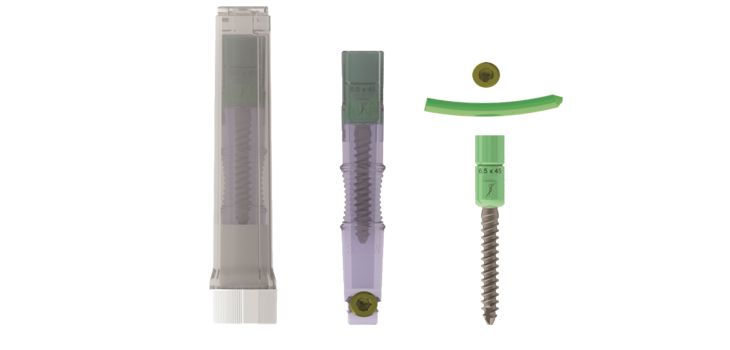
Spinal Balance, Inc. has recently introduced its Libra Pedicle Screw System, a pre-sterilized, individually packaged pedicle screw system which, says the company, features a first to market proprietary packaging and handling system (NT² inside).
Spinal Balance: Libra System Contains First-to-Market Features
2 min read Premium comments
Secondary
The May 9, 2016 news release indicates that the NT² inside “…prevents contaminants from contacting the surface of the pedicle screw and set screw during a procedure until implantation. The system is FDA cleared for trauma, deformity and degenerative applications in the T/L spine.”
“Deep bone infections [from whatever source] are a serious problem; keeping anything from touching or contacting the threads of a screw is very important. Our aim is to provide the surgeon with technically advanced implants that are easy to handle and can be implanted using improved aseptic technique, ” said CEO Anand Agarwal, M.D.
Don Kennedy, company director sales and marketing, told OTW, “Fundamentally we are trying to reduce variables in surgery that could lead to infections, especially deep bone infections. Our ability to provide pre-sterilized, uniquely packaged implants; specifically pedicle screws having our proprietary NT² inside ‘shield’ around the pedicle screw; act to prevent anyone from handling the implant until it is implanted in the patient. No one ever has to touch the implant prior to it being placed into a patient. No other company offers this ability and advancement in aseptic handling of the pedicle screw. It does matter to surgeons. One orthopedic surgeon who saw it commented: ‘nothing good happens from touching the implant.’ Secondly, having pre-sterilized implants reduces the standard and customary practice and requirement of reprocessing implants & instruments (in the trays), by one half. That generates significant time and cost savings to the hospital. We estimate this savings to be approximately $300/case. And lastly, it does happen at the time of surgery that trays (having reprocessed instruments and implants) are found to contain moisture (wet packs) or have torn wraps. In each of these instances those sets cannot be used in surgery. And if no other replacements are readily available, the patient cannot have surgery until the implants and instruments are reprocessed (again); this takes four hours. Imagine what that does to a surgery schedule.”
“Addressing the most interesting thing about the device, I would offer it is the improved packaging; our NT² inside shield coupled with being pre-sterilized. Those two packaging factors could reduce infections, will save hospitals time and money, and make it easy to recover from wet packs or torn drapes. Again, saving the hospital money and scheduling headaches.”
Author
React:
Discussion
This is a fascinating development. In my practice we've seen similar outcomes with the revised protocol. The key differentiator seems to be patient selection criteria. Has anyone else noticed the correlation with BMI thresholds?
Great point. I'd push back slightly on the conclusion, the sample size in the cited study is too small to draw population-level inferences. That said, the directional signal is compelling and worth a larger RCT.
We implemented a similar approach last year. Early results are promising but we're still gathering 12-month follow-up data. Happy to share our protocol if anyone is interested.
Join the conversation
Orthopedic professionals are discussing this. Sign in and upgrade to read every comment and add your voice.