
Sophisticated Robotic Hand Learns, Improves on Tasks
Sophisticated Robotic Hand Learns, Improves on Tasks; Psychological Effects of Scoliosis Treatment; Elaine Dennison, Olivier Bruyère Win IOF Award
7 min read Premium comments
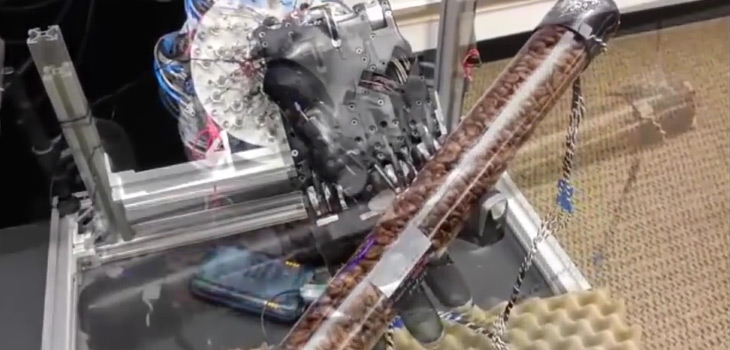
Get a grip! Not so easy if you are working with a robotic hand. Researchers from the University of Washington (UW) in Seattle are tackling the problem with the development of a sophisticated five-fingered robotic hand…one that can learn from its own experience without needing humans to tell it what to do. Vikash Kumar, a UW doctoral student in computer science and engineering, told OTW, “This robotic hand performs a set number of trials, and then goes for an improvement step based on the collective understanding obtained from the data of the performed trials.”
Regarding the design of their robotic hand, Kumar noted, “Our actuation system allows us to move the ShadowHand skeleton faster than a human hand (70 msec limit-to-limit movement, 30 msec overall reflex latency), generate sufficient forces (40N at each finger tendon, 125N at each wrist tendon), and achieve high compliance on the mechanism level (6 grams of external force at the fingertip displaces the finger when the system is powered.) This combination of speed, force and compliance is a prerequisite for dexterous manipulation, yet it has never before been achieved with a tendon-driven system, let alone a system with 24 degrees of freedom and 40 tendons.”
“There are a number of interesting robotic hands out there, but the fact that we have seldom seen them exploit their full dexterity in order to perform dynamics movements with free objects explains how challenging this problem is. Most real world applications resort to low dimensional custom designed (to fit the use-case) hands with stiff movements in order to sidestep the complexities of design, manufacturing and planning. If a robot butler or a fully functional prosthesis hand needs to become reality someday, they will likely need a dexterous manipulator capable of handling tasks of various nature and rigor. The goal of our research is to make progress towards this future by pushing the boundaries both in terms of design as well as planning/control of such devices.”
“Dexterous hand manipulation is one of the most complex types of biological movement, and has proven very difficult to replicate in robots. The usual approaches to robotic control—following pre-defined trajectories or planning online with reduced models—are both inapplicable. Dexterous manipulation is so sensitive to small variations in contact force and object location that it seems to require online planning. Here we are harmoniously bringing together concepts from the fields of Optimal Control and Machine Learning to design controllers that are capable of synthesizing dynamics dexterous maneuvers in real time for complicated high dimensional systems, while simultaneously learning from their own experience in order to improve their own abilities.”
Psychological Effects of Scoliosis Treatment
We often hear, “It’s not a diagnosis, it’s a whole individual.” That is certainly the case with the patients that the team from Mount Sinai Hospital chose to study. Baron Lonner, M.D. is a professor of orthopaedic surgery at that New York facility. He told OTW, “I have been practicing spine surgery for 20 years and am all too familiar with the distress that a diagnosis of scoliosis and subsequent treatment recommendation can cause for patients and their families. Nearly every time I prescribe a brace for an adolescent, it is traumatic; the child often has abundant tears, as do the parents. And while we have a conversation about how she or he should feel empowered about having control over their body and preventing progression of their curvature, not everyone is inspired by that message…and not everyone is compliant.”
“My colleagues and I have embarked on a multicenter study, with the pediatric arm including Mount Sinai Hospital, Children’s Hospital of Philadelphia, St Justine’s Hospital in Montreal, Quebec, and Children’s Hospital, Vancouver, British Columbia. The adult arm includes Mount Sinai Hospital, University of California San Francisco, and other New York hospitals.”
“This is a prospective study looking at three groups of pediatric patients: ones with relatively mild curves who will be observed, those who need a brace, and those who need surgery; there will be a control group of children without scoliosis. Going forward we will take a snapshot in time of their psychological makeup; we will also see how the treatment affects them psychosocially out to two years. We will use the Body Image Disturbance Questionnaire that our team developed for scoliosis, as well as the ASEBA [Achenbach System of Empirically Based Assessment], a comprehensive validated psychological questionnaire. We will do the same with the adult arm of the study.”
“I suspect we will find that these patients have issues of self image, self esteem, anxiety, and social avoidance behaviors. While those patients in the observation group will likely have minimal effects, those undergoing bracing may experience substantial psychological impact. As for the surgical patients, I think they will be noted to have significant preoperative psychological pathology that improves postoperatively.”
Asked what it is different about scoliosis patients who are better able to cope, Dr. Lonner notes, “There are just some kids for whom ‘water runs off their backs’ very easily. They are very self-assured and matter of fact. Others are on the quiet side and don’t handle being set apart from others well. For many, the severity of their situation can be exaggerated in their minds. We expect that the findings of this study will help tailor treatment for individuals based on psychological make-up and family and personal preferences and may guide a recommendation of psychological counseling for some individuals. Compliance in treatment and optimal outcomes are in part dependent on these factors. We have treated adult patients who appear to have experienced very profound psychosocial effects from their deformities. In some cases the patient underwent bracing with a Milwaukee brace, an apparatus which often evoked social embarrassment. We believe that surgical outcomes in these patients will likely be impacted by their psychological profile and should be understood.
“There are those who say that adolescent idiopathic scoliosis is a cosmetic disease…that you fix the curve to make the bump on the back go away. We believe, in addition to the sequelae of untreated scoliosis including back pain and disability in the adult, that there is likely to be a very significant psychosocial impact on the patient that persists into adulthood and affects many areas of the individual’s life.”
Professors Elaine Dennison, Olivier Bruyère Win IOF Young Scientist Award
Being recognized for their outstanding research are Professors Elaine Dennison and Olivier Bruyère, who have been named as the winners of the 2016 Pierre Meunier Young Scientist Awards, an award given by the IOF-ESCEO (International Osteoporosis Foundation-The European Society for Clinical and Economic Aspects of Osteoporosis and Osteoarthritis).
Elaine Dennison, MB BChir Cantab, MA, MSc, FRCP, PhD, is Professor of Musculoskeletal Epidemiology and Honorary Consultant in Rheumatology within Medicine at the University of Southampton. Professor Dennison’s work focuses on how events early in life interact with adult lifestyle factors to determine how we age; she has written over 150 scientific journal articles on this subject.
Professor Dennison commented to OTW, “To be recognized in this way is a great honor. This is an inaugural award named after a wonderful scientist, and this makes it particularly special. The coming months will be particularly busy. We have exciting plans for studies that will help us determine the factors that influence why some individuals age in musculoskeletal terms faster than others, in the hope that this will inform randomized controlled trials of interventions to slow the process.”
Olivier Bruyère, Ph.D. is Professor of Clinical Epidemiology in the Department of Public Health, Epidemiology and Health Economics and of Geriatric Rehabilitation in the Department of Sport Sciences of the University of Liège in Belgium. His main fields of interest are prevention, rehabilitation and pharmaco-epidemiology related to geriatric or rheumatic conditions. He is editor-in-chief of “The Archives of Public Health, ” and associate editor of BMC Musculoskeletal Disorders. He has written more than 200 international scientific publications and book chapters.
Professor Bruyère told OTW, “It was an honor and a privilege to receive this IOF/ESCEO 2016 Pierre Meunier Young Scientist Award. It is a testimony to the hard work of so many excellent team members and collaborators who have contributed to my research program, as well as my institution, the University of Liège, that has provided such welcome support.”
“Our next research will be to better understand the relationship between bone and muscle. Our main hypothesis is that there is a close relationship between bone loss and muscle loss over time. As a matter of fact, recent studies have suggested that bone and muscle wasting are closely interconnected. Dysfunction of the ‘muscle-bone unit’ generates an increased risk of morbid outcomes, i.e., injurious falls and fractures, physical disability, hospitalization, loss of independence and ultimately mortality. Our next objective will be, from two large cohorts, namely the SarcoPhAge (Sarcopenia and Physical impairment with advancing Age) study and the SENIOR study, to assess the relationship between age-related muscle and bone loss.”
“We have two cohorts of patients from different settings. The first cohort, called the SarcoPhAge study is a cohort of more than 500 community dwelling subjects assessed yearly for bone and muscle health. More particularly, we assess in these patients lean body mass with dual X-ray absorptiometry and bone mineral density and trabecular bone structure using the same apparatus.”
“In the second cohort, called the SENIOR (Sample of Elderly Nursing home Individuals: an Observational Research) study, we have included more than 600 subjects, residents in nursing home in Belgium. In these patients, we have body composition assessed by bioimpedancemetry and we also have blood samples that are currently frozen and on which we will be able to assess various biological markers of bone and muscle metabolism.”
React:
Discussion
This is a fascinating development. In my practice we've seen similar outcomes with the revised protocol. The key differentiator seems to be patient selection criteria. Has anyone else noticed the correlation with BMI thresholds?
Great point. I'd push back slightly on the conclusion, the sample size in the cited study is too small to draw population-level inferences. That said, the directional signal is compelling and worth a larger RCT.
We implemented a similar approach last year. Early results are promising but we're still gathering 12-month follow-up data. Happy to share our protocol if anyone is interested.
Join the conversation
Orthopedic professionals are discussing this. Sign in and upgrade to read every comment and add your voice.