
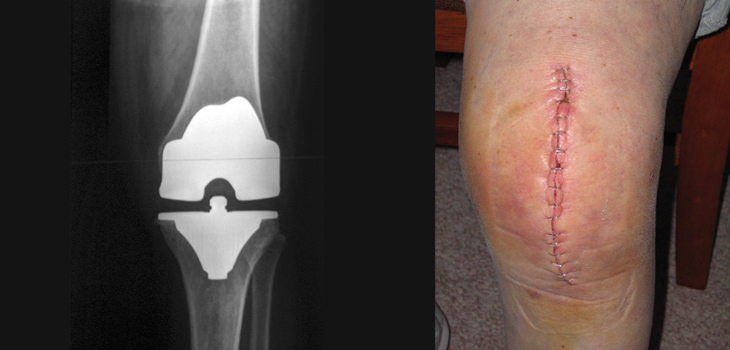
Now THIS is news patients will be glad to hear! New research from Loyola Medicine suggests that knee replacement patients can get in the shower before previously thought, meaning that they don’t necessarily have to wait up to two weeks postop.
Researchers to Knee Patients: “Go Ahead and Shower”
1 min read Premium comments
Secondary
As stated in the May 13, 2016, news release, “The study compared patients who were allowed to shower two days after surgery with patients who had to wait 10 to 14 days. Researchers performed bacterial culture swabs of skin next to incisions, and no differences were found between the early shower and delayed shower groups. No patient in either group experienced an infection. As expected, patients overwhelmingly preferred being allowed to shower early.”
The study, published in the Journal of Arthroplasty, involved 32 knee replacement patients operated on by Harold Rees, M.D., an orthopedic surgeon at Loyola University Medical Center. Dr. Rees specializes in knee and hip replacement and was a corresponding author of the study.
As indicated in the news release, “Sixteen patients were randomly assigned to the early shower group and 16 were randomly assigned to the delayed shower group. The early shower patients were allowed to shower two days after surgery, after their dressings were removed. Patients in the delayed shower group were not allowed to shower until 10 to 14 days after surgery. Following surgery, 94% of the early shower group and 81% of the delayed shower group reported that early showering was important to them, and that they would have preferred to do so if given the choice.”
Dr. Rees told OTW, “A lot of patients have asked us whether they could shower earlier, because they do not like having to wait up to two weeks. So we conducted a study to establish whether it would be safe to shower earlier.”
Dr. Rees concluded, “It is safe to allow patients to shower earlier. We performed culture swabs of skin adjacent to incisions, and found no differences between early shower and delayed shower groups.”
React:
Discussion
This is a fascinating development. In my practice we've seen similar outcomes with the revised protocol. The key differentiator seems to be patient selection criteria. Has anyone else noticed the correlation with BMI thresholds?
Great point. I'd push back slightly on the conclusion, the sample size in the cited study is too small to draw population-level inferences. That said, the directional signal is compelling and worth a larger RCT.
We implemented a similar approach last year. Early results are promising but we're still gathering 12-month follow-up data. Happy to share our protocol if anyone is interested.
Join the conversation
Orthopedic professionals are discussing this. Sign in and upgrade to read every comment and add your voice.