
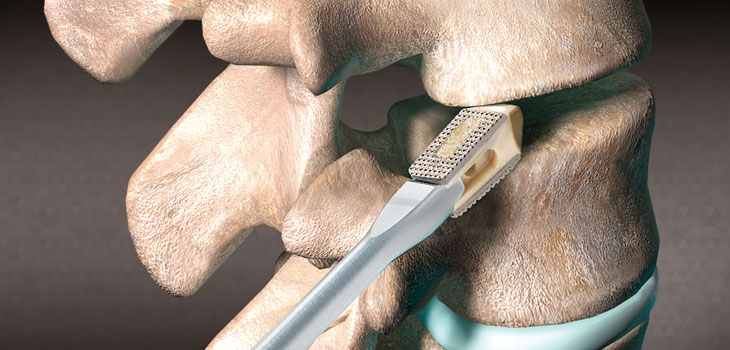
Orthofix International N.V. is bringing the first interbody spacer system to the spine market which combines PEEK and 3D-printed titanium end plates into a single porous interbody solution for lumbar spine fusion procedures.
Orthofix Claims First PEEK/Titanium Lumbar Spacer
2 min read Premium comments
Secondary
On May 16, 2016, the company announced the Forza PTC (PEEK Titanium Composite) Spacer System has received FDA 510(k) clearance and will be launched on a limited basis. The company first introduced this proprietary design with the launch of Construx Mini PTC into the anterior cervical interbody spacer market in 2013. Orthofix claims to be the only company with a spacer designed to provide both the imaging benefits of PEEK and the bone ingrowth results of a porous titanium surface.
The titanium endplates, according to the company, are manufactured using advanced 3D-printing technology to specific pore size, interconnectivity and porosity requirements.
“Literature has shown that interconnected pores greater than 300 microns in diameter are ideal for bone growth through porous biomaterials, ” noted the company. The Forza PTC is designed with interconnected 400 micron diameter pores and 50% porosity to optimize the potential for bone ingrowth. “This may compare favorably to the bone ongrowth potential of traditional plasma titanium coated interbodies with less than 100 micron pore diameter.”
The company told OTW that pivotal to the design of the spacer is the use of Direct Metal Laser Sintering (DMLS), an additive manufacturing technique used to produce the 3D porous titanium endplates. This process enables the creation of complex 3D structures that the company says were once nearly impossible to create with traditional manufacturing techniques.
The 3D porous titanium endplates are bonded to a PEEK (polyether ether ketone) core using a proprietary design and injection molding. That design, claims the company, assures a solid bond between the PEEK and 3D porous titanium, eliminating the possibility of the PEEK flowing into the porous scaffold. The endplates are also much thicker (900 microns) than PEEK surface coatings such as Plasma Titanium Coating (<100 microns) so bone can grow into the structure and not just on the surface. The devices come in both curved and straight versions in a full range of implant sizes to accommodate different anatomies.
The PEEK core is radiolucent for post-operative assessment of fusion.
The company says the spacer system is indicated for spinal fusion procedures in skeletally mature patients with degenerative disc disease at one or two contiguous levels in the lumbar spine (L2-S1) and is intended for use with autograft and/or allograft comprised of cancellous and/or corticocancellous bone graft and supplemental fixation, e.g., Firebird Spinal System. Patients must have undergone a regimen of at least six months of non-operative treatment prior to being treated with the system.
Ray Fujikawa, president of Orthofix Spine Fixation, said the addition of the system to the company’s lumbar spine fixation portfolio “demonstrates our commitment to innovation in the spine market and to delivering solutions that help improve patients’ lives.”
The system was co-developed by Scott Stanley, M.D., an orthopedic surgeon. Stanley said the system offers a “unique porous technology that allows patient bone ingrowth into the surface of the implant as well as bone growth through the center of the device. Additionally, the PEEK core allows for clear imaging so physicians can assess the patient’s fusion maturation post-operatively to determine if enough healing has occurred for return to regular activities.”
Author
React:
Discussion
This is a fascinating development. In my practice we've seen similar outcomes with the revised protocol. The key differentiator seems to be patient selection criteria. Has anyone else noticed the correlation with BMI thresholds?
Great point. I'd push back slightly on the conclusion, the sample size in the cited study is too small to draw population-level inferences. That said, the directional signal is compelling and worth a larger RCT.
We implemented a similar approach last year. Early results are promising but we're still gathering 12-month follow-up data. Happy to share our protocol if anyone is interested.
Join the conversation
Orthopedic professionals are discussing this. Sign in and upgrade to read every comment and add your voice.