
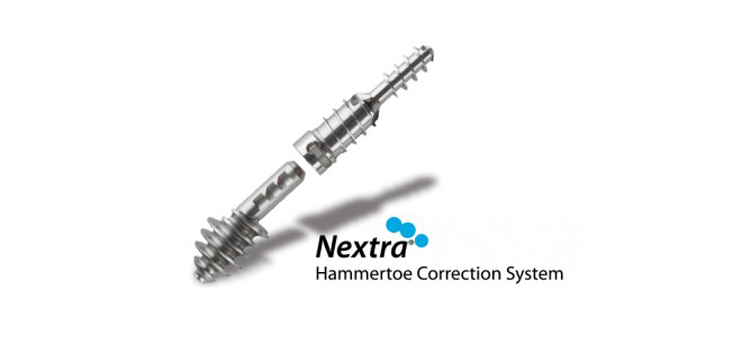
New research, featured in the The Journal of Foot and Ankle Surgery, has found that the Nextra Hammertoe Correction System works better than the traditional Kirschner Wires (K-wires). The Nextra device is a two-piece implant developed by Nextremity Solutions, Inc. according to the May 16, 2016 news release, “This device differed from K-wires by achieving more than a 5x higher rate of bone fusion. Additionally, the Nextra implant exhibited an 84% fusion rate, compared to just 16% with K-wires.”
Nextremity‘s Nextra Fares Well in RCT
2 min read Premium comments
Secondary
Mike Coon, executive director of sales & marketing for Nextremity Solutions, Inc., noted, “Some of the issues with the utilization of K-wires in hammertoe surgery are a lack of fusion, lack of rotational stability, risk of infection with post-operative K-Wire exposure, and poor patient satisfaction. According to the study, patients with the Nextra implant not only had drastic improvements in fusion rates but also experienced greater pain relief, a decrease in disability and an increase in activity levels. Simply put, the Nextra patients had greater patient satisfaction outcomes. These clinically proven results help to redefine the standard of care for hammertoe patients.”
Executive Director of Product Development for Nextremity Solutions, Ryan Schlotterback, commented, “This study is a great example of our commitment to proving the clinical efficacy and benefits of our products and technology. Nextremity Solutions will continue to work with our surgeon partners to develop innovative solutions with improved and proven clinical outcomes. We are steadfast in our belief that the foot and ankle market is primed for continued advancements that lead to better surgical outcomes and patient satisfaction.”
Schlotterback told OTW, “I don’t believe we would consider the results surprising, but rather good support of the anecdotal data and feedback from our surgeon customers. We were very pleased with the confirmation of a significant improvement in fusion rates, overall activity scores as well as other study metrics of the patients undergoing hammertoe correction surgery with the Nextremity Hammertoe Correction System. It is not surprising that patients enjoy having more successful outcomes while at the same time not having to endure 4-6 weeks with pins protruding from their foot.”
“We hope that with the clinical study results of efficacy and improved outcomes we continue to see growth of the Nextra Hammertoe Correction System and that these results help redefine the standard of care. We want to continue to see surgeons and patients be the beneficiary of our innovative products.”
Author
React:
Discussion
This is a fascinating development. In my practice we've seen similar outcomes with the revised protocol. The key differentiator seems to be patient selection criteria. Has anyone else noticed the correlation with BMI thresholds?
Great point. I'd push back slightly on the conclusion, the sample size in the cited study is too small to draw population-level inferences. That said, the directional signal is compelling and worth a larger RCT.
We implemented a similar approach last year. Early results are promising but we're still gathering 12-month follow-up data. Happy to share our protocol if anyone is interested.
Join the conversation
Orthopedic professionals are discussing this. Sign in and upgrade to read every comment and add your voice.